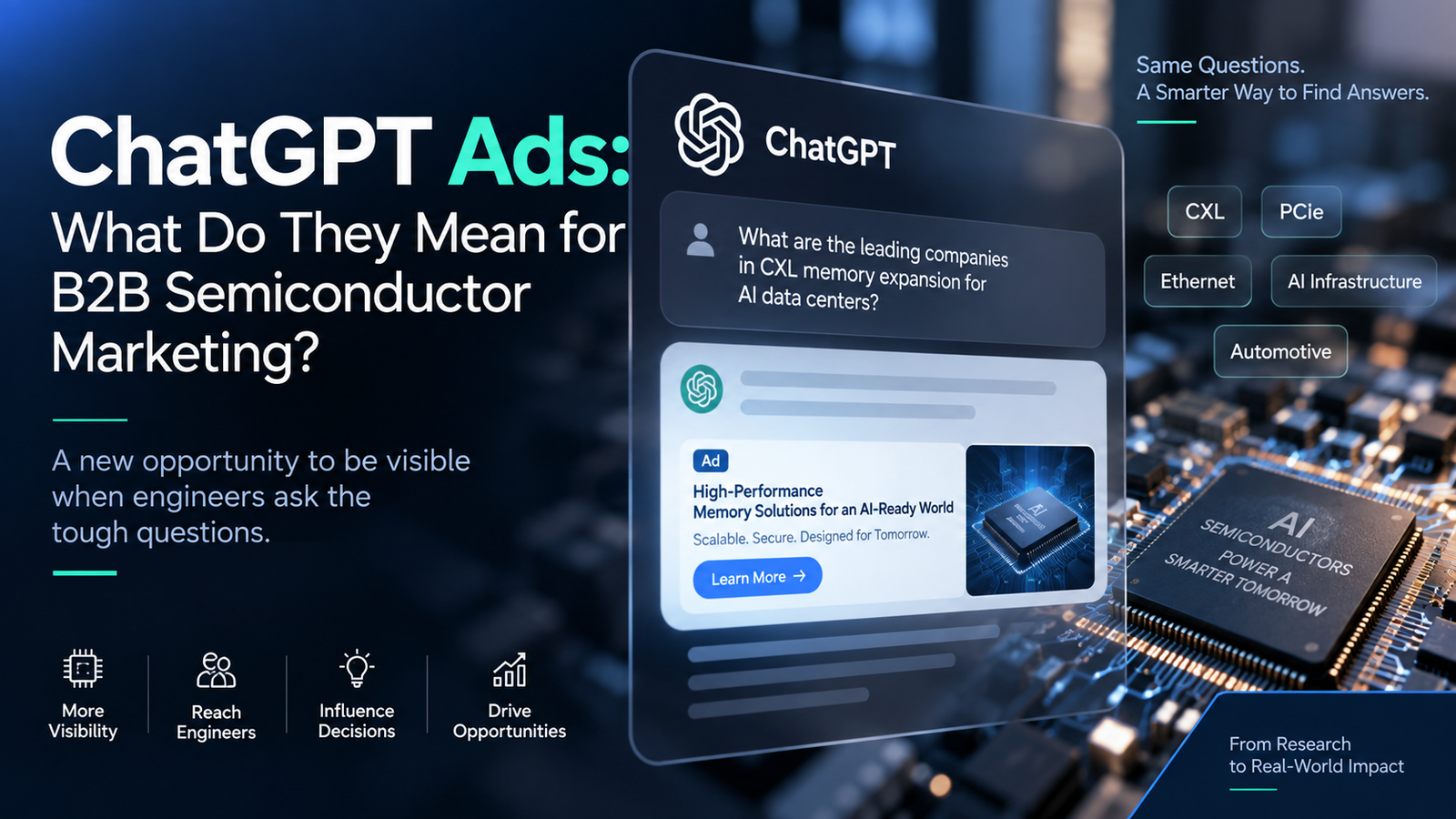
The way people search for information has changed significantly. Google is still important, but it’s no longer the only place where buyers research products and technologies. Today engineers, procurement teams and technology leaders increasingly use AI-powered platforms like ChatGPT, Google AI Overviews, Gemini and Microsoft Copilot to research products, compare technologies and evaluate vendors.
For B2B semiconductor companies and deep tech startups this shift changes how digital visibility is earned. Ranking for a handful of keywords is no longer enough. Companies must demonstrate expertise across an entire technology domain so that both search engines and AI systems recognize them as trusted authorities.
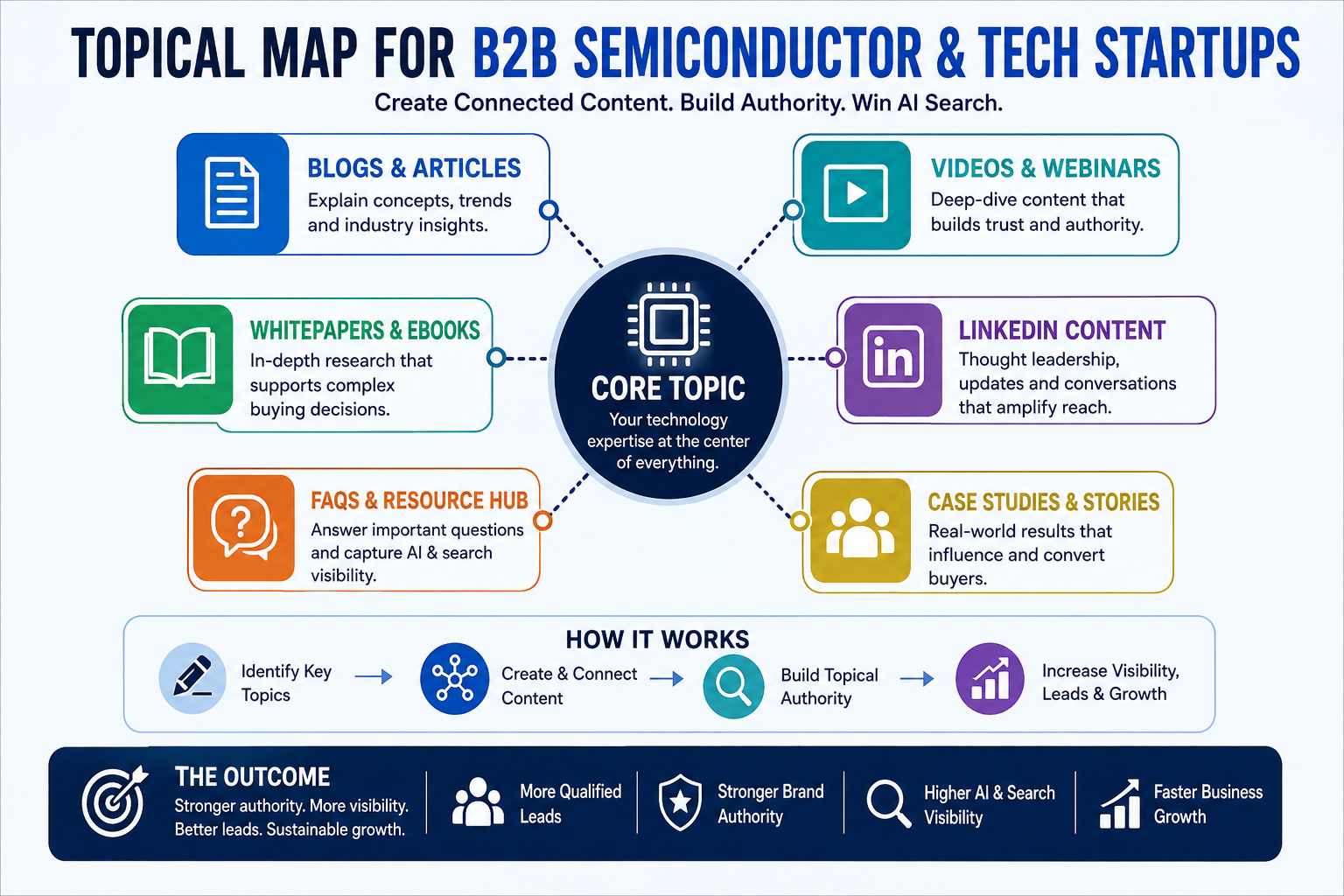
This is where a topical map becomes one of the most valuable assets in your content strategy.
What Is a Topical Map?
A topical map is a structured content framework that organizes everything your company knows about a specific subject.
Instead of publishing disconnected blog posts or occasional product announcements every piece of content supports a broader knowledge ecosystem.
For example, if your company develops AI networking solutions your topical map might include:
- Ethernet fabrics
- Scale-up networking
- Scale-out networking
- AI clusters
- Optical interconnects
- Large language model training
- Power efficiency in AI data centers
Each topic links naturally to related content creating a comprehensive resource that helps both users and AI understand your expertise.
Why Traditional SEO Is No Longer Enough
Many B2B companies still measure success by keyword rankings.
While keywords remain important modern search engines evaluate much more than individual pages. AI-powered search looks for organizations that consistently publish accurate, connected and trustworthy information.
Imagine these two companies:
Company A
- Publishes five product pages
- Writes two press releases each year
- Occasionally posts on LinkedIn
Company B
- Maintains detailed product pages
- Publishes technical blogs
- Produces whitepapers
- Shares webinar recordings
- Creates comparison guides
- Posts executive insights on LinkedIn
- Releases customer success stories
- Links all content through a structured topical framework
Which company is more likely to become the trusted source cited by AI?
Most of us would choose the second company and that’s exactly the point. Authority is built through depth, consistency and interconnected knowledge.
AI Search Rewards Expertise, Not Just Keywords
Large language models don’t simply count keywords. They evaluate relationships between concepts, entities, brands and expertise.
For semiconductor companies, this means content should demonstrate knowledge across the technologies surrounding your products.
For example, if you manufacture optical DSPs your content shouldn’t stop at product specifications. It should also cover:
- AI data center architectures
- Optical networking trends
- PAM4 technology
- Energy efficiency
- Network scaling challenges
- Future AI infrastructure
This broader context helps AI understand where your expertise fits within the industry.
Think Beyond Product Pages
One of the biggest challenges in semiconductor marketing is the limited amount of product content available at launch.
Fortunately, every product announcement can generate months of valuable content.
A single product launch can inspire:
- Technology overview articles
- “How it works” explainers
- Customer use cases
- Industry trend analyses
- Executive interviews
- Webinar presentations
- FAQ pages
- Infographics
- LinkedIn thought leadership posts
- Technical comparison guides
Each piece reinforces the others strengthening your topical authority over time.
Connect SEO and Social Media
Many marketing teams treat SEO and social media as separate activities.
In reality they should work together.
Consider this integrated approach:
1. Publish a technical blog explaining a new AI networking technology.
2. Create LinkedIn posts highlighting key insights from the article.
3. Share short video clips featuring product managers or engineers.
4. Host a webinar exploring the technology in greater depth.
5. Convert webinar questions into FAQ content.
6. Update product pages with new resources.
7. Link every asset together.
This creates multiple entry points for users while sending strong authority signals to search engines and AI platforms.
Build Around Pillar Topics
Rather than chasing hundreds of unrelated keywords focus on a few strategic technology pillars.
For a semiconductor company these might include:
AI Infrastructure
- Accelerated computing
- AI clusters
- GPU networking
- AI factories
- Rack-scale architecture
Connectivity
- Ethernet
- Optical networking
- PAM4 DSPs
- Coherent DSPs
- Silicon photonics
Storage
- NVMe
- SSD controllers
- Data movement
- Storage acceleration
Custom Silicon
- ASIC design
- Chiplet architecture
- HBM integration
- Custom AI accelerators
Each pillar should include supporting blogs, videos, whitepapers, product pages, FAQs and case studies that link together.
Let Your Experts Become Your Brand
People trust people more than logos.
Engineers, architects, product managers, CTOs and executives possess valuable expertise that often remains hidden inside the organization.
Encourage them to share:
- Industry observations
- Technical perspectives
- Lessons learned
- Innovation stories
- LinkedIn articles
These authentic voices strengthen your company’s credibility while supporting Google’s E-E-A-T principles Experience, Expertise, Authoritativeness, and Trustworthiness.
Measure Authority, Not Just Rankings
Keyword rankings still matter, but they are only one indicator of success.
Modern B2B marketers should also monitor:
- Organic traffic growth
- AI search visibility
- Backlinks from authoritative websites
- Content engagement
- Topic coverage
- Executive thought leadership performance
- Lead quality
- Conversion rates
The goal is not simply to rank it is to become the recognized authority in your market.
A Practical Framework for Tech Startups
Even small marketing teams can implement a topical strategy.
Start with these five steps:
1. Identify three to five core technology themes aligned with your business.
2. Create pillar pages for each theme.
3. Publish supporting content consistently, including blogs, videos, FAQs and whitepapers.
4. Connect all related content through internal links.
5. Amplify every major article through LinkedIn, newsletters, webinars and industry communities.
Over time, this interconnected ecosystem becomes increasingly valuable to both search engines and AI assistants.
Final Thoughts
The future of B2B digital marketing is no longer about publishing more content it’s about publishing connected, authoritative and experience driven content.
For semiconductor companies and technology startups a well designed topical map transforms isolated marketing assets into a cohesive knowledge hub. It helps search engines understand your expertise, improves visibility in AI-powered search experiences and builds trust with engineers, decision makers and potential customers.
Organizations that invest in topical authority today will be better positioned to earn visibility not only in Google Search but also in the AI assistants that are shaping how buyers discover and evaluate technology.
As AI continues to redefine search the question is no longer “Which keywords should we rank for?” It’s “How can we become the most trusted source of knowledge in our industry?”
About DreamJ Digital
At DreamJ Digital, we help B2B technology companies, semiconductor organizations and AI startups build digital strategies that go beyond traditional SEO. By combining technical content, AI search optimization (GEO), Answer Engine Optimization (AEO), topical authority, and thought leadership, we help brands increase visibility, credibility and demand in an AI-first search landscape.