


How enterprise content teams can navigate the generative search era without abandoning what works
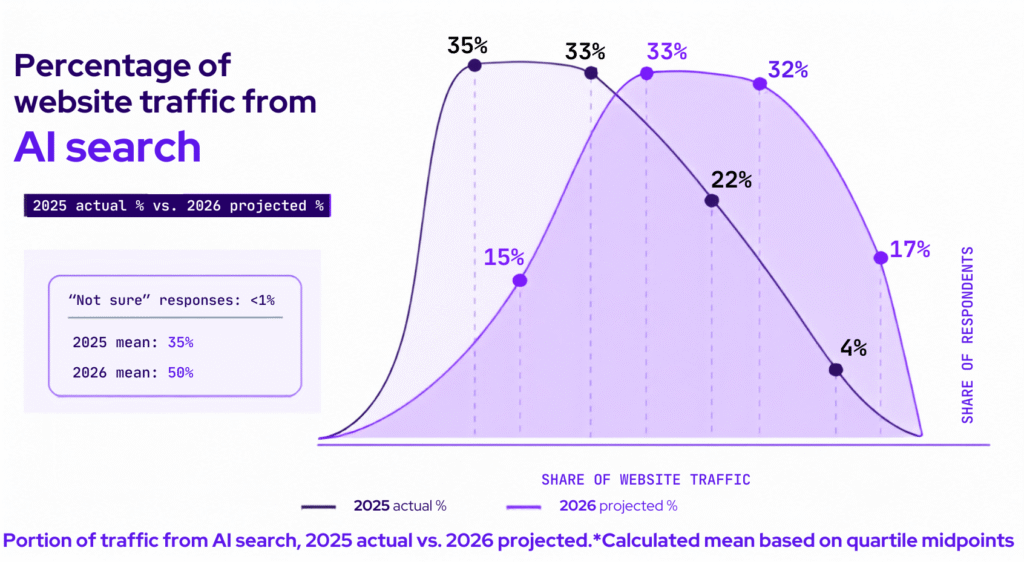
AI search has gone from zero to dominant channel in under three years. From virtually nothing in 2023, AI-driven discovery now accounts for a mean of 35% of all website traffic at enterprise companies a trajectory that took traditional organic search decades to achieve.¹ Yet the expected consequence that this rise signals the death of SEO turns out to be a false premise. The data tells a more nuanced and ultimately more actionable story for enterprise marketing and web teams.
A Bigger Search Landscape, Not a Zero-Sum Trade
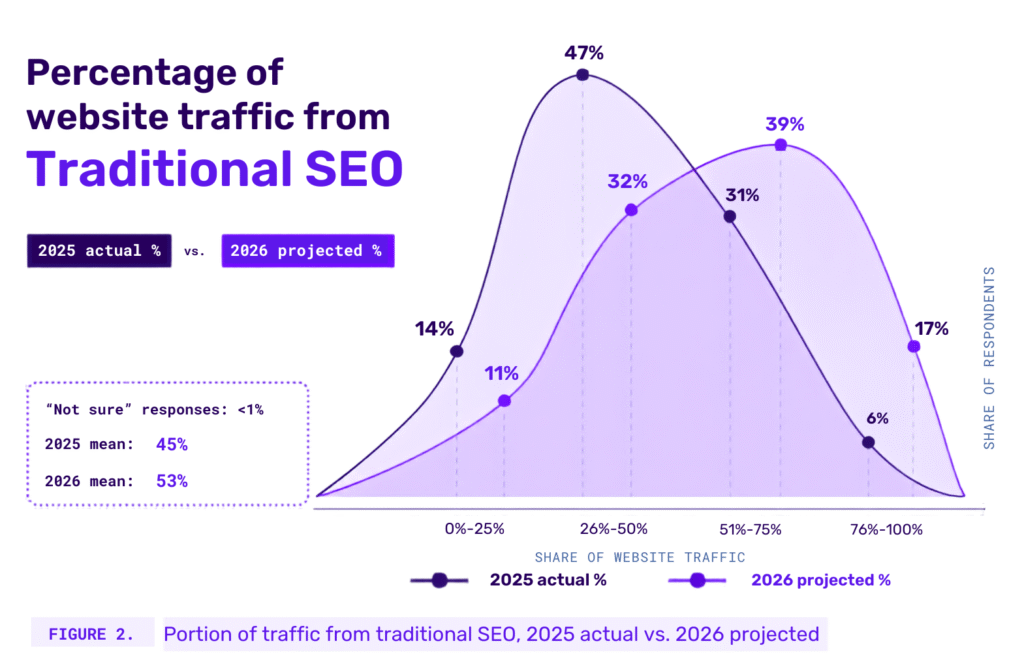
The most important thing enterprise marketing leaders need to understand about AI search is that it is not taking market share from traditional SEO. Both channels are growing simultaneously. A survey of 300 enterprise marketing executives found that traditional SEO traffic share is projected to grow from 45% in 2025 to 53% by end of 2026 an eight point increase happening in parallel with AI search expansion.¹
This coexistence is structural. Users now refine ideas in AI tools, then pivot to traditional search with more precise queries producing more complex, multimodal search behavior across the funnel. The two channels are amplifying each other, not competing for a fixed pool of user attention. For enterprise companies with complex B2B buyer journeys, this expanded discovery funnel is an opportunity: every stage of that research cycle is now a potential point of visibility.
Why Is AI Search Additive Rather Than a Replacement for Traditional SEO?
The structural reason AI search and SEO coexist comes down to how AI engines actually work. Most major AI search platforms Google AI Overviews, ChatGPT search and Perplexity pull from the same web indexes that traditional search engines crawl. Google AI Overviews cite top 10 organic search results 76.1% of the time, which means a page with poor search engine visibility is largely invisible to AI summary engines as well.²
Strong organic search performance is a prerequisite for AI citation not an alternative to it.
The discipline that sits on top of SEO is now called Generative Engine Optimization (GEO) the practice of structuring content so that AI powered engines can accurately extract, cite and recommend it. If SEO is about ranking, GEO is about being part of the answer. They are complementary layers, not competing tactics.
What Enterprise Content Teams Must Change Now
Operating in both channels means content strategy must serve both algorithmic ranking and AI extraction simultaneously. Traditional search rewards keyword relevance and authority signals. AI engines reward structured, factual, extractable content: short answer passages, specific data points, named technologies and consistent entity definitions.
There is also a structural conflict enterprise teams must actively manage. In traditional SEO, a brand can maintain pages targeting opposite intents one page positioning a product as premium, another as affordable. Search engines serve each to its respective query. A large language model aggregates all signals for that entity and synthesizes one answer. Conflicting signals produce either an inaccurate brand representation or an absence from the response entirely. Enterprise content architecture must align signals consistently across all owned properties.
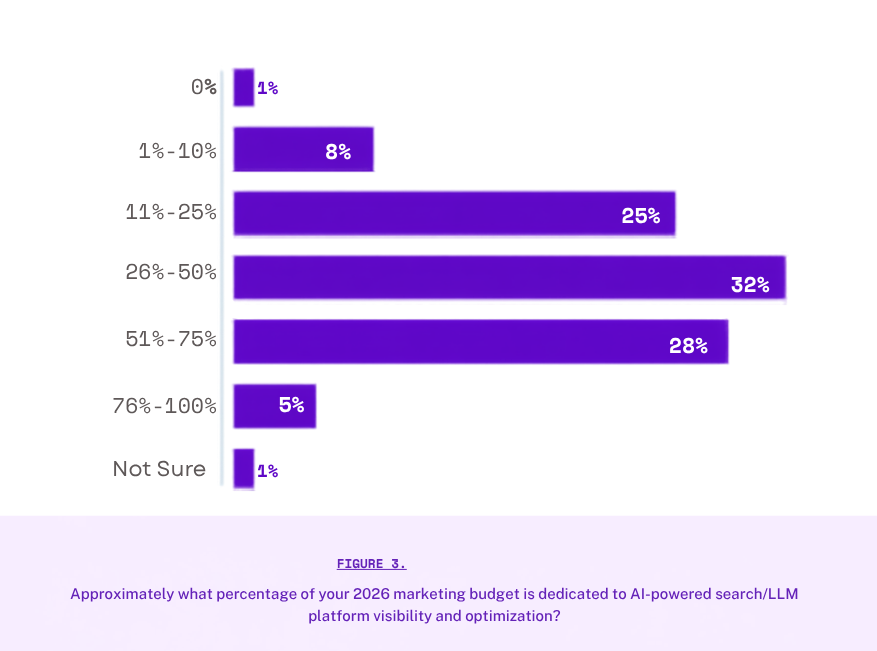
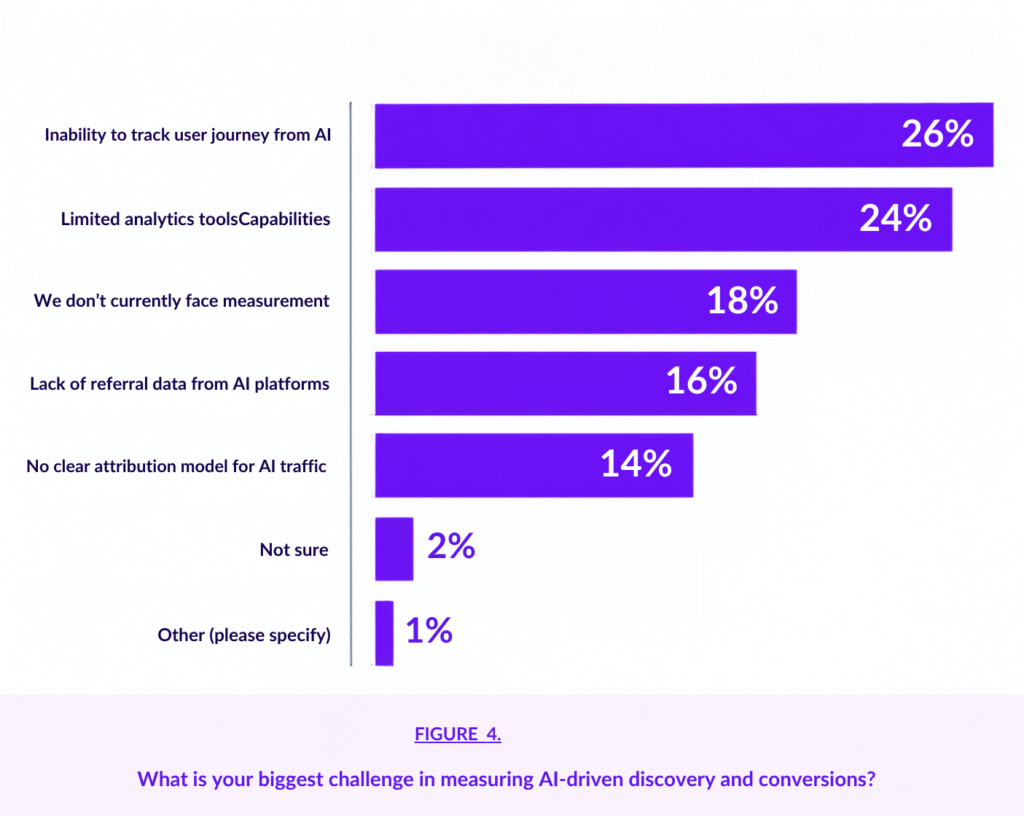
Measurement is the other major challenge. The same survey found that 65% of enterprise executives are allocating at least 25% of their total marketing budget to AI search, while 66% still report significant challenges with measurement basics.¹
Fewer than 1 in 5 report no challenges at all. AI referred traffic is surfacing inside branded search growth, direct traffic lifts and unexplained conversion spikes not as a cleanly separate line in standard attribution dashboards.
The practical steps for enterprise web and content teams are actionable even while the broader measurement ecosystem matures:
- Instrument every source. Organic, paid, AI platform referrals and direct traffic all need measurement the first party data foundation built today feeds the attribution models required tomorrow.
- Audit content for consistency. Contradictory signals across owned pages undermine AI search visibility. A structured content audit is the fastest way to identify and resolve those conflicts.
- Embed structured answer passages. Two-to-four sentence direct answers within longer content are exactly what AI engines extract and surface. Every high intent topic in the portfolio deserves at least one.
For semiconductor and technology infrastructure companies, this is a natural advantage. Years of publishing precise technical content specific numbers, named technologies and cited data points is exactly what AI engines use when selecting sources to cite. That depth is now a dual channel asset, provided the architecture is designed to be both rankable and extractable.
Building the Measurement Foundation for What Comes Next
The attribution frameworks required to measure AI search at scale are still being built and the measurement gap will widen before it narrows.
The most durable position is to focus on end impact metrics rather than platform reported attribution measuring actual business outcomes against platform investment. Tracking AI share of voice how often a brand appears in AI generated answers for priority queries is emerging as the GEO equivalent of organic search ranking and dedicated monitoring platforms are now mature enough for enterprise deployment.
The companies that build lasting visibility in the AI search era are not those that pivot entirely to GEO or double down on traditional SEO alone. They are the teams that treat AI search as an additive force one that rewards the same fundamentals of structured, credible content that good SEO has always required, applied with greater precision across a more complex surface.
AI search has not replaced SEO. It has extended the discovery funnel, raised the bar for content architecture and introduced a measurement challenge that enterprise teams will spend the next several years resolving. Getting the content strategy right for both channels simultaneously is not a future investment. It is a present-tense competitive requirement.
Sources
- Branch, “AI Search and Discovery Enterprise Benchmark Report,” Search Engine Journal, June 10, 2026. https://www.searchenginejournal.com/enterprise-ai-search-report
- OptimizeGEO, “Generative AI SEO: Complete Strategy Guide for AI-Search in 2026,” June 3, 2026. https://www.optimizegeo.ai/blog