


Yes, small semiconductor startups can compete with giants in AI search rankings — by being faster, sharper, and more focused.
AI search rewards precision and credibility, not size or budget.
Startups can win by mastering these key factors:
- Focusing on a specific technical niche
- Publishing fresh and transparent data
- Using structured and machine-readable content
- Building founder-led, expert-driven authority
- Optimizing for AI answers (AEO), not just Google SEO
- Sharing open benchmarks and datasets
- Moving faster than large competitors
- Expanding early into AI-native platforms (Perplexity, ChatGPT, Gemini)
But if you’re not fully convinced yet, that’s completely fine.
Understanding how semiconductor startups can compete with giants — takes time.
As the saying goes, “Knowledge is not something you get instantly; it’s something that grows as you keep exploring.”

Why Ranking High in AI Search Matters
1. People are already using AI tools as a search alternative
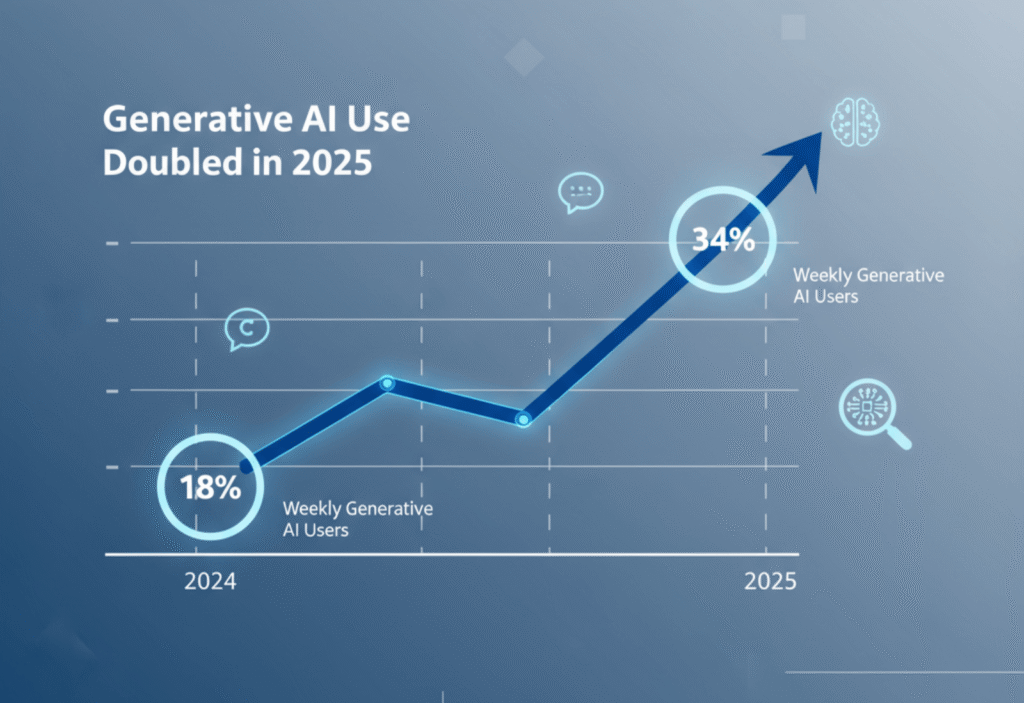
- Regular use is mainstream: Weekly use of generative AI nearly doubled year-over-year (18% → 34% in 2025), and overall familiarity hit 61% across countries studied. That means more queries are happening inside AI tools, not just classic search engines.
- Information seeking is the top use-case: A 2025 AP-NORC poll found 60% of U.S. adults use AI to search for information—the most common use. Younger adults do this even more.
- ChatGPT used “like a search engine”: Surveys summarized by TechRadar report 77% of U.S. users primarily use ChatGPT as a faster, conversational alternative to search.
2. AI surfaces are becoming default entry points
- Google AI mode: rolled out to U.S. users in May 2025, building on AI Overviews. Google said AI Overviews had reached ~1.5B monthly users, showing how prominent AI-answers now are in the core search experience.
But wait — if AI answers everything upfront, does this affect clicks to the actual websites?
Let’s look at what the data says next.
3. Yes, AI summaries reduce clicks
- Evidence shows a clear CTR drop: Ahrefs and eMarketer (2025) found that when AI Overviews appear, click-through rates drop by ~30–35% on average. For informational searches, position 1 CTR fell from 0.056 → 0.031, confirming that users rely more on AI summaries than traditional links.
- User behavior shifts, not vanishes: Pew Research (2025) observed that when an AI summary appears, traditional link clicks drop to 8% (vs. 15%), yet session-ending rates rise to 26% — meaning users often find their answers directly in the AI response. That makes being mentioned inside the summary more valuable than before.
4. Why AI Search Ranking Still Matters
- Brand visibility still counts: When your company, product, or research is cited in an AI Overview, users still see and remember your brand — even without a click. That recall builds long-term trust.
- Builds authority and credibility: Appearing in AI-generated results signals to both users and algorithms that your content is reliable and expert-backed, strengthening your site’s E-E-A-T (Experience, Expertise, Authoritativeness, and Trust).
- Smarter, higher-intent traffic: The few users who do click from AI results are often more engaged and ready to act, since they already filtered through the summary.
Who Dominates the AI Search Landscape Right Now?
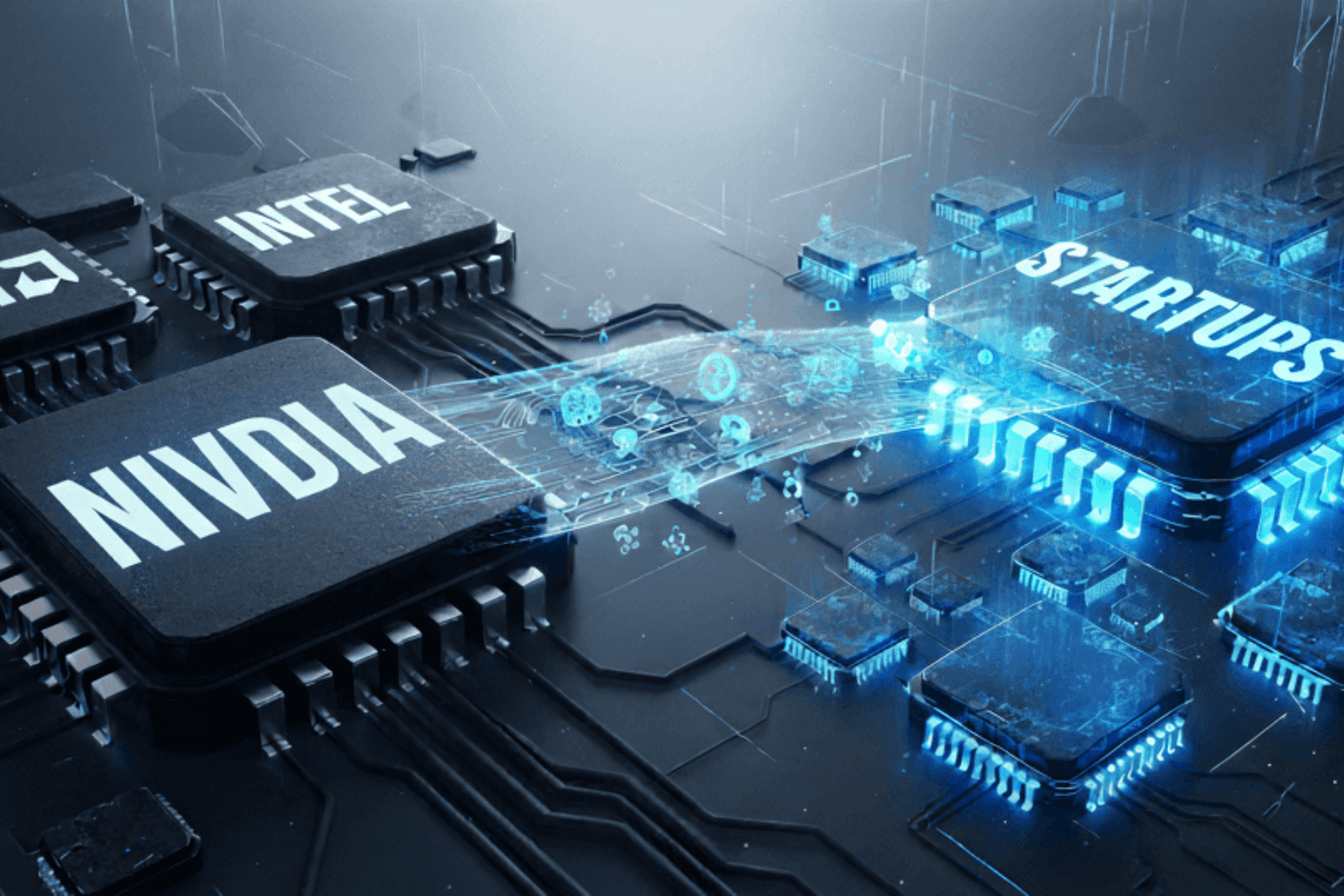
When it comes to visibility in AI search — whether on Google’s AI Overviews, ChatGPT, Gemini, or Perplexity — a few big players consistently dominate the results. These companies aren’t just leading in technology; they’ve also built strong digital authority, brand recognition, and content ecosystems that AI engines rely on for answers.
Below are some of the key giants shaping the AI search space:
| Company | Segment | Visibility Reason |
| NVIDIA | GPUs for AI training & inference | Market leader; its GPUs power 80–90% of AI models. Most AI discussions mention NVIDIA first. |
| AMD | AI accelerators (MI300, Instinct) | Strong media visibility as the main challenger to NVIDIA. |
| Intel | CPUs + AI accelerators (Gaudi) | Legacy brand with heavy coverage in AI hardware. |
| Qualcomm | Edge AI (Snapdragon X Elite, AI PCs) | Strong visibility in on-device and mobile AI. |
| TSMC | Semiconductor manufacturing | Backbone of chip production for NVIDIA, AMD, and Apple; often cited in AI supply chain stories. |
| Samsung | AI memory and semiconductor design | Visibility in AI memory, mobile chips, and foundry technology. |
How Tech Giant Semiconductor Companies Stay on Top of AI Search Rankings
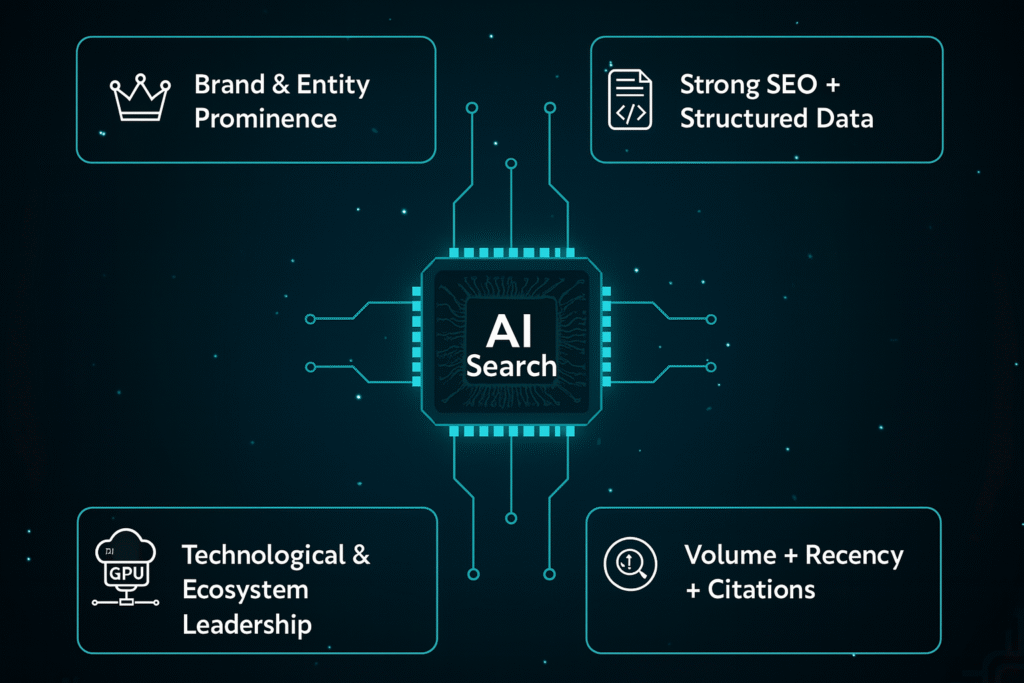
Large semiconductor firms maintain their dominant position in AI-search visibility by executing coordinated strategies that combine brand authority, technical leadership, and search optimization for AI-driven platforms. Below are the key components of their approach.
1. Brand & Entity Prominence
- Research shows that in AI answer engines (e.g., ChatGPT, Gemini, Perplexity, and AI Overviews) strong brand mentions correlate much more with visibility than traditional link metrics. For example, one study found the correlation coefficient between branded web mentions and AI Overview brand visibility was 0.664—much higher than backlinks at 0.218.
- Another study of AI Overviews found a strong bias toward major-known outlets and entities: smaller domains rarely get cited.
- Because these giants are recognized across the web (news, research, websites), AI systems preferentially select them when generating answers.
2. Strong Traditional SEO + Structured Content
- Companies ranking high in traditional organic search tend to dominate in AI-search citations too: one study found ~40% of media URLs mentioned in AI Overviews already sat in the top 10 of traditional search results.
- In addition, AI search engines favour pages with good metadata, schema markup, freshness, and technical clarity. An empirical academic study found that structured data, freshness, and semantic HTML were among the strongest predictors of being cited by AI answer engines.
- Giants maintain vast, updated content libraries: technical specs, research papers, white-papers, benchmarks—all of which feed AI systems with easily consumable data.
3. Technological & Ecosystem Leadership
- In the AI hardware domain, NVIDIA reportedly holds ~80% of the AI accelerator market.
- Their dominance isn’t just hardware: they offer developer ecosystems (CUDA, SDKs), platforms and services that ensure their products get mentioned in articles, research, developer forums, benchmarks and therefore searched and cited.
- When a product becomes a go-to solution (e.g., for large language models, inference, edge AI), every conversation, article or query about that segment implicitly references the brand—which boosts search-visibility.
4. Volume + Recency + Citations
- Research on AI Overviews shows a recency bias: more than 50 % of citations in some datasets are from 2024–2025, indicating that freshness matters.
- These companies release frequent updates, benchmarks, and product announcements—keeping them in the flow of “what’s new” that AI tools pick up.
- They are also heavily covered in credible sources—analyst reports, press releases, research papers—which increases their citation footprint. AI answer engines tend to cite sources that are already well-cited elsewhere.
How Semiconductor Startups Can Compete and Win
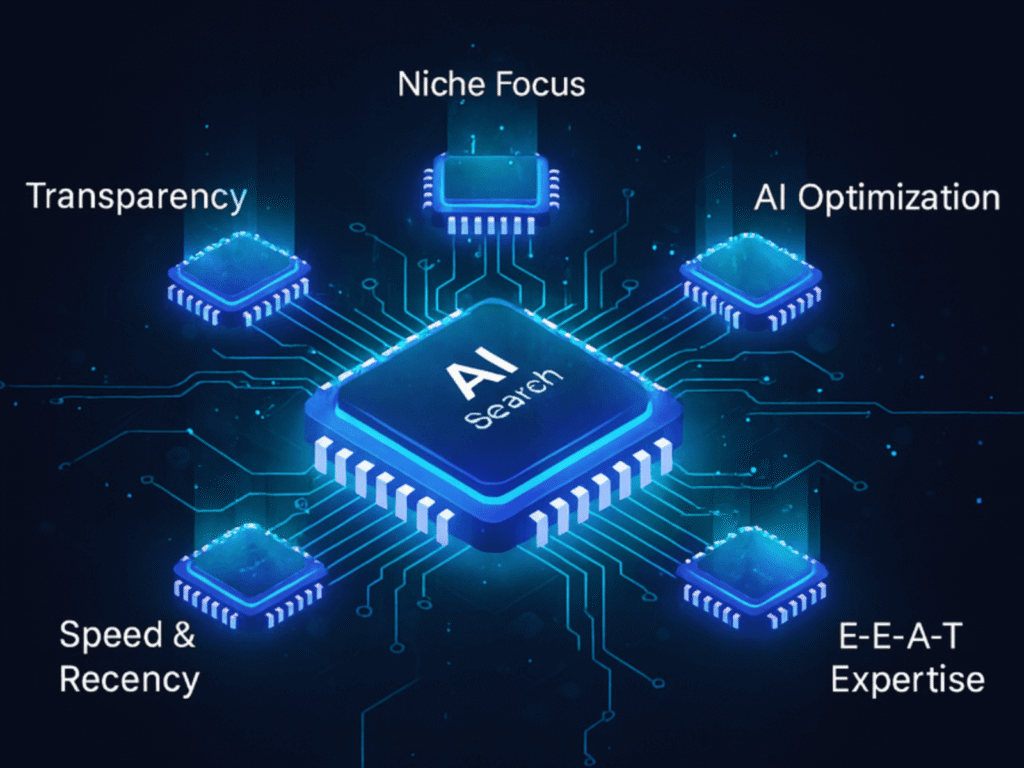
1. Win Through Hyper-Niche Authority (Where Giants Go Broad, You Go Deep)
Large semiconductor companies chase broad, high-volume keywords and topics like “AI chips,” “GPU performance,” or “AI acceleration.”
But this leaves a massive gap in long-tail, ultra-specific technical queries — the kind that AI search engines increasingly favor.
These are questions giants rarely target, such as:
“Most power-efficient inference chip under 30ms latency for edge devices,”
“Best low-cost ASIC for transformer inference,” or
“How does in-memory computing reduce power draw in AI inference workloads?”
These hyper-specific topics are where startups can dominate.
According to Google for Developers (2025), AI Overviews prioritize content that “answers clearly scoped, intent-focused questions.”
By focusing on micro-niches within the semiconductor ecosystem — such as edge inference optimization, wafer-scale computing, or photonic AI architectures — startups can build unmatched topical depth.
In practice:
- Create deep-dive answer content addressing one precise engineering problem per post.
- Add FAQ and How-To schema markup to help AI models extract those direct answers.
- Use clear technical comparisons (e.g., latency per watt, throughput per token, or transistor density improvements) to make your content machine-readable and citation-worthy.
Giants build highways — broad, brand-driven content.
Startups build precision roads — focused, technically rich content.
And AI engines reward the roads less traveled because they deliver the clearest, most verifiable answers.
2. Move Faster Than Giants (Recency Is Your Superpower)
AI Overviews and Perplexity both show a recency bias, with over 50% of citations coming from content published in the past year (SE Ranking, 2025).
This gives startups a unique edge — not because they publish more, but because they can publish faster.
Large companies maintain recency by releasing predictable updates — product launches, quarterly reports, and benchmark events.
Startups, on the other hand, can move in real time: publishing architecture notes, chip design insights, or open benchmark data within days of discovery.
That agility lets startups capture visibility spikes before the giants’ next press cycle even begins.
To stay ahead:
- Use Google Trends, ArXiv Sanity, or Perplexity Topics to spot new AI chip trends early.
- Create a “fast update format” — short, technical blog posts or visual tables summarizing new data or comparisons.
- Treat every new benchmark or research release as a content opportunity.
Giants stay relevant by scale; startups stay relevant by speed.
In AI search, the first credible answer often beats the biggest brand.
3. Build Trust Through Transparency and Open Data
AI models favor sources they can read, verify, and cite easily. While large firms release polished reports, much of their technical detail is hidden in PDFs or gated documents that AI crawlers can’t parse. Startups can flip this advantage by:
- Publishing open, text-based benchmark results, comparison tables, and downloadable CSV datasets.
- Making every metric machine-readable and source-attributed.
- Using structured markup (JSON-LD) to label specifications, power ratings, and model comparisons.
According to Perplexity AI (2025), “AI systems tend to cite open, technically transparent sources over gated or commercial content.”
Openness is authority. In AI search, transparency is your credibility.
4. Optimize for AI Answers, Not Just Blue Links (AEO > SEO)
Traditional SEO focuses on ranking in Google’s 10 blue links.
But AI-driven search (ChatGPT, Gemini, Bing Copilot) uses AI Engine Optimization (AEO) — understanding and structuring your content so that it can be quoted inside AI-generated answers.
To achieve this:
- Use question-based H2s (e.g., “What is the most power-efficient inference chip for mobile AI?”).
- Provide concise 2–3 sentence summaries immediately after each heading.
- Add FAQ schema for every recurring technical query.
- Ensure semantic clarity — e.g., clearly distinguish “AI accelerator” vs “edge NPU” using consistent markup.
Microsoft Ads’ AEO Guide (2025) highlights that “AI engines reward answer-first content with structured clarity over keyword density.”
For startups: Don’t compete on backlinks — compete on clarity.
5. Leverage Founder-Led Expertise and E-E-A-T
Big corporations often sound corporate.
Startups can sound human, expert, and trustworthy — the exact qualities AI systems use to judge E-E-A-T (Experience, Expertise, Authority, Trust).
- Publish founder- or engineer-authored articles, with full author credentials and links to profiles (LinkedIn, research papers).
- Share first-hand experience — like chip test data, lab learnings, or internal experiments — instead of generic overviews.
- Participate in open forums, podcasts, or webinars, then link back to your own technical content.
Google’s “Helpful Content” update (2025) emphasizes authentic, experience-based content as a key ranking signal — both for search and AI visibility.
People trust people — and AI learns trust the same way.
6. Expand Beyond Google: Seed Emerging AI Ecosystems
While giants dominate Google and Bing, AI-native engines like Perplexity, You.com, and OpenAI’s SearchGPT are more open to citing smaller, credible sources.
- Studies by Perplexity AI (2025) show that it cites non-top-10 sources in over 35 % of results — significantly more than Google.
- Startups should ensure their content is indexable and cited in these new ecosystems early.
- Publishing clear data-backed answers and open whitepapers can get you cited without having to outrank giants on traditional SERPs.
AI search is expanding fast — get in early while citation equity is still open.
Industry Parallel: From Chip Innovation to AI Search Strategy
The semiconductor race offers a perfect metaphor for AI search visibility.
Just as startups like Groq, Cerebras, and d-Matrix are challenging NVIDIA in hardware performance by focusing on specific problems instead of mass scale, designing specialized architectures, being faster to innovate, smaller companies can win in AI search rankings by mastering specific niches, more transparent, and more technically precise than the giants.
Both battles—hardware and AI visibility—are about precision, credibility, and innovation, not size.
Here’s how the two worlds mirror each other
| Hardware Competition (Semiconductor Industry) | AI Search & SEO Competition (Digital Visibility) |
| i) Specialized Chip Design (Focus Beats Scale) Startups like Groq and Cerebras don’t try to replicate NVIDIA’s massive GPU ecosystem. Instead, they focus on narrow, high-value segments like inference acceleration, wafer-scale compute, or edge efficiency. | ii) Specialized Content Niches (Precision Beats Volume) Similarly, startups should focus on narrow, high-intent topics (e.g., “best edge-AI chip for robotics” or “in-memory inference optimization”). AI engines reward focus and clarity over generic coverage. |
| ii) Innovative Architecture (Unique Design Philosophy) d-Matrix uses in-memory computing to cut data movement delays, while Tenstorrent leverages chiplet modularity for flexible scaling. | ii) Structured Content Architecture (Smart Information Design) Use clear heading hierarchies (H2s as questions), schema markup, and tightly structured answers to help AI engines “read” your content efficiently. Innovation in how you organize data online = performance gains in AI ranking. |
| iii) Benchmark & Research Credibility (Trust via Proof) Cerebras and NextSilicon gained attention not through ads, but through benchmark data and peer-reviewed performance results that earned them credibility. | iii) E-E-A-T Credibility (Trust via Expertise) Likewise, startups can publish transparent benchmarks, case studies, and first-hand technical documentation—all tied to real author expertise—to earn citations in AI-generated answers. |
| iv) Power Efficiency & Sustainability (Smart Optimization) Startups like Vaire and Rebellions focus on perf-per-watt efficiency—doing more with less. | iv) Content Efficiency (Smart SEO Investment) Instead of producing hundreds of broad posts, startups can invest in fewer data-rich, high-trust articles that continue earning citations over time—a “low-power, high-impact” approach to SEO. |
| v) Local & Regulatory Adaptation (Regional Strategy) Firms like Cambricon or Biren succeed in China’s market by designing region-compliant AI chips within export restrictions. | v) Regional SEO & Localization (Geo-Targeted Strategy) Target specific regions or languages where giant brands have less presence. Regional content (e.g., “AI chip manufacturing in India” or “EU semiconductor compliance”) can dominate local AI search results. |
| vi) Ecosystem Collaboration (Open + Agile) Many startups survive by joining open alliances or integrating with hyperscaler frameworks (e.g., AWS partnerships, open-source SDKs). | vi) Community Collaboration (Open + Credible) Collaborate with universities, AI forums, or developer communities. Encourage backlinks, citations, and discussions that naturally build semantic authority—the “open ecosystem” equivalent in SEO. |
Staying First: How to Maintain Your AI Search Position
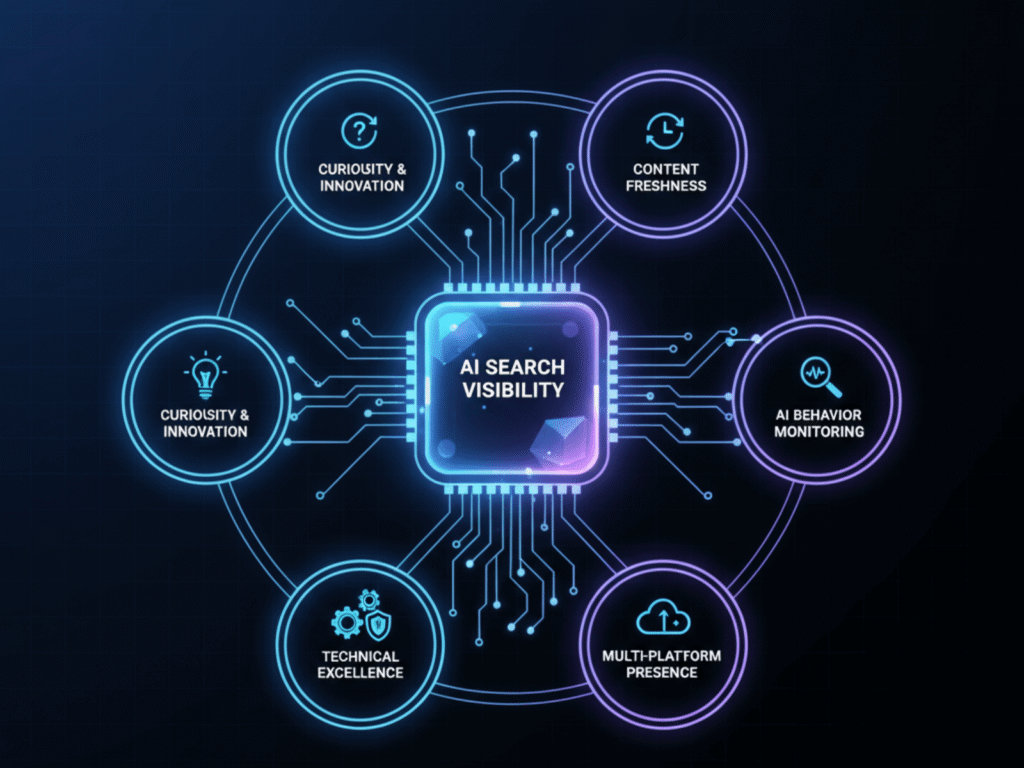
Winning an AI search ranking is one thing — staying there is another game entirely.
AI engines evolve rapidly, data models update, and content that was once “fresh” can become outdated within weeks.
Just as hardware startups need constant iteration to stay ahead of NVIDIA’s next chip, maintaining your position in AI visibility requires continuous optimization and adaptation.
Here’s how to protect and grow your AI search presence over time
1. Keep Your Content Fresh and Contextually Updated
AI answer engines, including Google’s AI Overviews and Perplexity, heavily favor recent content — SE Ranking’s 2025 report showed 55% of citations came from pages published within the last 12 months.
- Refresh top pages every 2–3 months with new benchmarks or studies.
- Use tools like Originality.ai AEO Tracker or Perplexity Alerts to spot visibility drops.
- Add real updates — not just new dates.
Like chip design: each new version should perform better, not just look newer.
2. Monitor AI Search Behavior — Not Just Google Rankings
Traditional SEO tools show you keyword rankings, but AI search visibility depends on how often your brand or content is cited in AI answers.
- Monitor citations in ChatGPT, Gemini, Bing Copilot, and Perplexity.
- Track entity mentions (your brand or chip name).
- Watch emerging AI engines like You.com and SearchGPT for early visibility.
You’re no longer optimizing for clicks — you’re optimizing for mentions.
3. Adapt to Data and Search Intent
AI search systems constantly learn from user engagement — what users click, save, or expand affects future answer models.
Staying visible means aligning your content with ongoing search intent shifts.
- Track user behavior (time on page, scroll depth, feedback).
- Use tools like Clearscope or MarketMuse to fill content gaps.
- Keep structured data clean so AI can reindex you easily.
Treat content like software — update, test, repeat.
4. Maintain Technical Excellence (Clean, Fast, Structured)
Even the most insightful content can lose ranking if the site’s technical signals weaken.
AI crawlers depend on clarity, structure, and accessibility.
- Audit Core Web Vitals and fix speed issues.
- Use clear schema markup for FAQs, How-Tos, and specs.
- Maintain stable URLs and redirect old links properly.
A clean website is like a well-routed chip — fast, efficient, and reliable.
5. Stay Curious and Adaptive
AI search isn’t static. Each month, ranking logic evolves as models retrain with new data.
The only sustainable strategy is curiosity and iteration.
- Follow AI SEO research updates (SE Ranking, Ahrefs, Search Engine Journal).
- Revisit your AEO strategy quarterly.
- Treat ranking drops as data to improve, not defeat.
In both chips and content — improvement never stops.
FAQ
1. How can a startup with limited resources prove its expertise and trustworthiness (E-E-A-T) to AI?
You don’t need a huge budget to earn trust. Highlight your founder’s background, share real case studies, and collect client testimonials or media mentions. These are the credibility signals that help both people — and AI models — see your brand as reliable and authoritative.
2. How often should a semiconductor startup publish content to stay visible?
Try to share or update something at least every few weeks — whether that’s a short technical post, a benchmark result, or a whitepaper. Consistency shows AI engines (and your audience) that you’re active, relevant, and on top of fast-moving trends like AI chips or edge inference.
3. What is “Query Fan-Out,” and how can my startup use it?
Think of “Query Fan-Out” as taking one idea and branching it into many related questions — the kind users actually ask in AI tools. You can use AI keyword tools or topic generators to find these long-tail questions and create focused content that answers them clearly.
4. How important are mentions on Reddit, Quora, or other forums?
Super important! AI tools love pulling information from authentic discussions on Reddit, Quora, and industry communities. If people are talking about your brand or product there, it helps AI see your company as part of real conversations — which boosts your chances of being cited in AI answers.
5. What’s the most important metric for small companies in the “Answer Engine” era?
Focus on how often your brand is mentioned inside AI-generated answers. That’s the new visibility metric — even if users don’t click, they still see your name. Being part of the answer means your company is trusted enough to represent the solution.
Conclusion: The Proof Is in This Page
If you’ve read this far, you haven’t just learned how small semiconductor startups can compete with tech giants in AI search rankings —
you’ve experienced a live demonstration of it.
This entire blog is structured using the same Generative Engine Optimization (GEO) principles that help modern content earn visibility inside AI search results:
1. Question-led subtopics and schema-ready structure
Every section was designed to mirror how AI understands intent — using natural-language questions, FAQ-style formatting, and How-To logic that makes the content easy for AI engines to extract and cite.
2. Research-backed, well-structured content
Each point is supported with credible citations from sources like Pew, Ahrefs, and SE Ranking — reinforcing E-E-A-T (Experience, Expertise, Authoritativeness, Trust) while keeping the flow clear for both readers and AI crawlers. The structure itself follows a logical pattern — starting with a direct answer, then expanding with data and examples — reflecting how AI models prefer concise insights followed by detailed context.
3. Readable yet technically rich format
From bold keywords and short paragraphs to organized lists and comparison tables, this blog balances technical precision and accessibility — the same balance that helps content perform in both human and AI-driven searches.
In short, this article doesn’t just talk about how startups can compete — it actually embodies that strategy.
Key takeaway:
You don’t need the biggest name to lead in AI search — you just need to structure your knowledge clearly, cite your facts credibly, and speak to both people and algorithms with intent.
So, if this post ever appears inside an AI-generated answer,
remember — that’s not luck.
That’s GEO in action.