


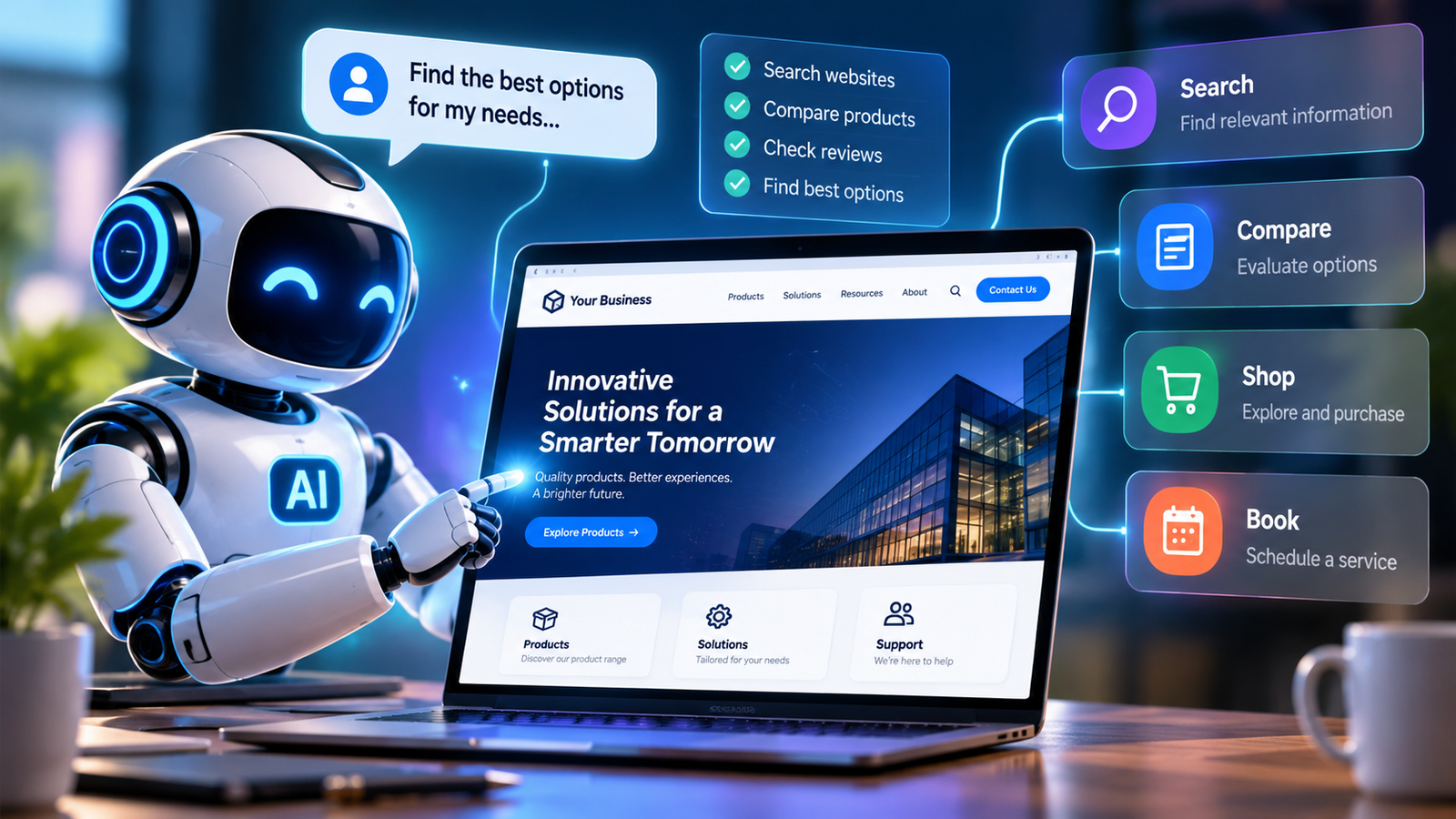
Artificial intelligence (AI) is changing the way people search for information, discover products and interact with businesses online. Until recently, most customers used search engines such as Google to find websites, compare products and make purchasing decisions. Today, AI tools are beginning to take over some of these tasks.
Personal AI agents, such as Meta Muse and OpenAI’s Dots, represent an emerging step in this transformation. Instead of simply answering questions, these tools can help users research products, navigate websites, fill out forms and perform other online tasks.
For businesses, this development raises an important question: Is your website ready for a future where AI agents may act on behalf of your customers?
1. What Are Personal AI Agents?
Imagine you want to buy a laptop. Normally, you would search Google, visit several websites, compare prices, check specifications and select the product that meets your needs.
Now imagine asking an AI assistant to do much of this work for you.
You could simply say, “Find a laptop under ₹60,000 with 16 GB RAM and good battery life.” An AI agent could help research suitable options, compare features and potentially assist with the purchase.
This is the basic idea behind personal AI agents. They go beyond answering questions by helping users complete tasks.
For businesses, this means customers may increasingly rely on AI tools to discover products and services instead of visiting websites themselves.
2. Why AI Agents Matter for SEO
Search engine optimization (SEO) has traditionally focused on helping websites appear in search results. Businesses improve their content, keywords, page structure and backlinks to attract visitors.
However, AI agents introduce another consideration: a website must not only be discoverable but also easy for AI systems to understand and use.
Consider an online store that sells shoes. If its product pages clearly display prices, available sizes, colours, delivery details and return policies, an AI agent has a better chance of understanding the available options.
If important information is hidden inside images or displayed through confusing website elements, the agent may struggle to interpret it correctly.
This is why good SEO practices, clear content and accessible website design are becoming increasingly important.
3. Make Your Website Easy for AI to Understand
A well-structured website benefits both human visitors and AI-powered tools.
Here are some important areas businesses should review:
Use clear headings: Organize content with meaningful headings and subheadings. Each page should have a clear purpose, making it easier for visitors and automated systems to understand the information.
Write descriptive links: Instead of using generic phrases such as “Click here,” use descriptive link text such as “Explore our SEO services.” This tells visitors and AI tools what to expect when they follow a link.
Add meaningful image descriptions: Use appropriate alternative text for important images. This helps people using screen readers and provides additional context about the images on your website.
Display important information as text: Product prices, service descriptions, specifications and availability should be presented as readable website content rather than appearing only inside images.
Use clear calls to action: Buttons such as Request a Quote, Book a Consultation and Contact Our Team explain exactly what visitors can do next.
These improvements can make your website easier to navigate, understand, and interact with.
4. Website Accessibility Is More Important Than Ever
Accessibility means designing websites so that people with different abilities can use them effectively.
For example, buttons should have clear labels, forms should identify the information required and navigation should work properly with a keyboard.
These features are important for people who use assistive technologies. They can also help AI agents understand website elements and interact with them more reliably.
Imagine a customer asking an AI agent to book a consultation. If your website has confusing forms, unlabeled fields or buttons that do not work correctly, completing the booking may become difficult.
Therefore, accessibility should not be treated as an optional website improvement. It is an important part of delivering a better digital experience.
5. Traditional SEO and AI Search Must Work Together
Does the growth of AI mean businesses should stop investing in traditional SEO? Absolutely not.
Search engines still help people discover websites, while AI-powered search tools can summarize information and recommend relevant sources.
Personal AI agents add another possibility: interacting directly with websites to complete tasks.
Businesses should therefore focus on three connected goals:
- Search engine optimization (SEO): Help customers discover your website through traditional search engines.
- Generative engine optimization (GEO): Make your content clear, useful and suitable for discovery or citation in AI-generated answers.
- Website usability: Make it easy for visitors and compatible AI agents to navigate your website and complete important actions.
These approaches complement one another. Strong technical foundations, useful content, clear information and a good user experience remain valuable across different discovery channels.
6. Will AI Agents Affect Website Analytics?
AI-driven interactions may also change how businesses measure website performance.
For example, an AI agent might visit a website and browse products just as a human customer would. Standard analytics tools may record that activity as a website visit without clearly identifying it as agent-driven activity.
In other situations, a customer may complete a purchase through an integrated AI shopping experience without visiting the retailer’s website checkout pages. Depending on the integration, the transaction may appear in the store’s order records but not as a conventional website conversion.
Businesses should review their analytics setup and understand how traffic, leads and sales are recorded across different platforms.
As AI-driven customer journeys evolve, measuring business outcomes will become just as important as tracking website traffic.
7. How Can Businesses Prepare Today?
Businesses do not need to rebuild their websites immediately to prepare for this change. A practical starting point is to review the website’s existing strengths and weaknesses.
Start by checking whether important pages load correctly, whether headings and links are descriptive, and whether service information is easy to find. Test contact forms, booking systems and checkout processes to ensure they work reliably.
Review your mobile experience, improve accessibility and ensure that key information is available as readable text. Continue investing in useful, accurate content that answers real customer questions.
Finally, monitor developments in AI search and agent technology. The tools and standards are evolving, so businesses should test improvements rather than rely on assumptions about how every AI agent works.
Conclusion: Prepare Your Website for the Next Phase of Digital Marketing
Personal AI agents could change how customers discover businesses, compare options and complete online tasks. While the pace of adoption remains uncertain, the direction is clear: websites need to do more than attract visitors.
They must communicate information clearly, provide accessible experiences and make important actions easy to complete.
For businesses, the best starting point is not abandoning traditional SEO but building on it. A website with useful content, strong technical foundations, accessible design and intuitive navigation will be better positioned to serve both today’s customers and tomorrow’s AI-assisted experiences.
At DreamJ Digital, we believe the future of digital marketing lies in combining strong SEO strategies, AI-driven innovation and user-friendly website experiences to help businesses grow online.

