If you’ve been waiting for clarity on whether AI search is a threat to SEO or a complement to it, the data is finally in — and it’s more nuanced than the hype suggests.
A benchmark survey of 300 enterprise marketing executives sheds light on how large organizations are navigating the AI search revolution. The findings challenge some popular assumptions and surface a few problems that most marketing teams aren’t yet equipped to handle.
Here’s what you need to know.
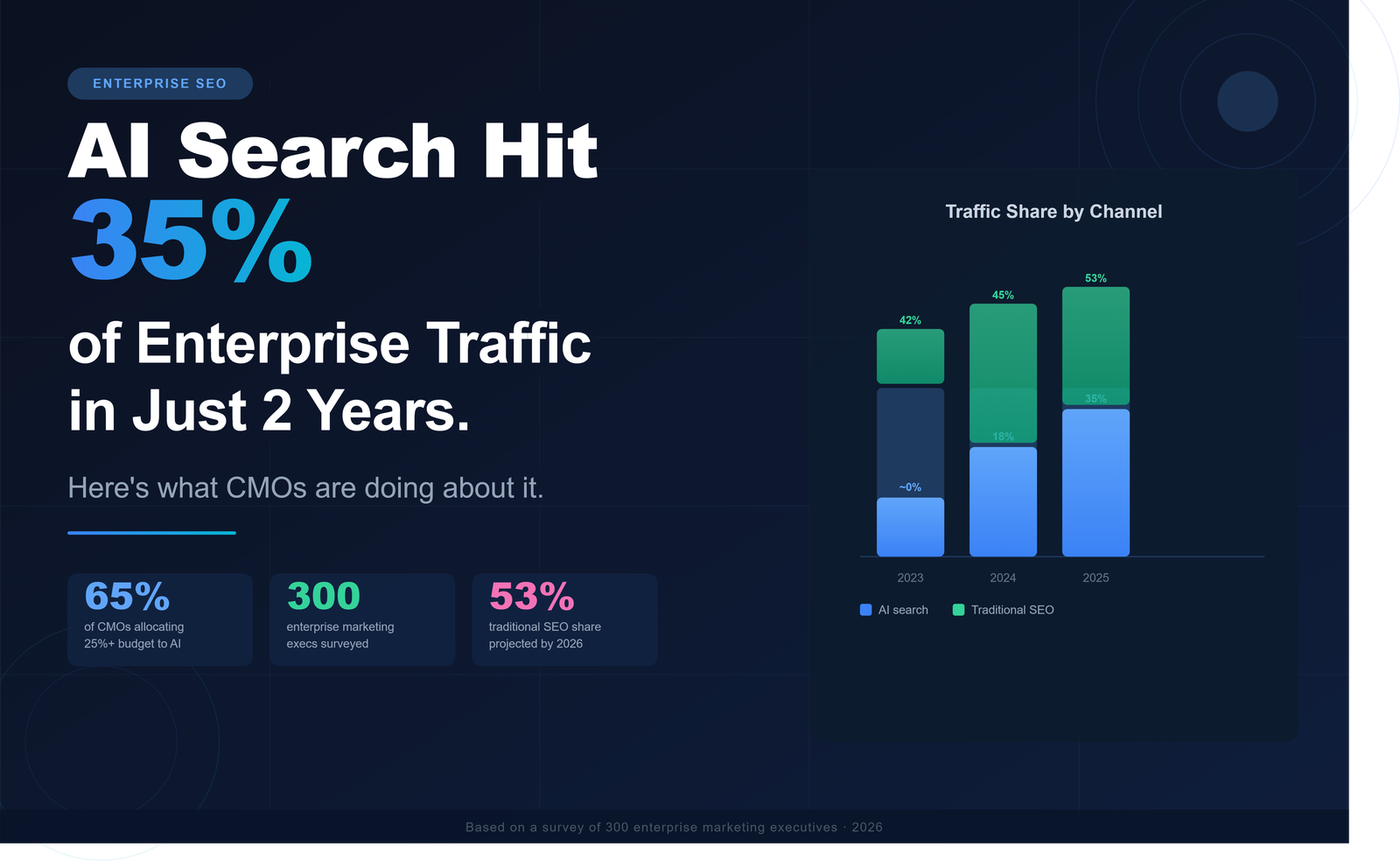
AI Search Now Drives 35% of Enterprise Website Traffic
In just two years, AI-powered search tools — ChatGPT, Google AI Overviews, Perplexity, and others — have gone from virtually zero to accounting for a mean of 35% of all website traffic for enterprise brands.
That kind of growth is extraordinary. Channels that took decades to mature have been leapfrogged in roughly 24 months. And understandably, this fueled widespread predictions that traditional SEO was finished.
But the data tells a more interesting story.
SEO Isn’t Dead — Both Channels Are Growing
Here’s the counterintuitive finding: traditional SEO’s share of web traffic isn’t shrinking — it’s growing. Survey respondents predicted it will climb from 45% in 2025 to 53% in 2026.
How is this possible if AI search is also growing?
Think about how you personally use these tools. You might ask ChatGPT to help you compare two laptops, get a recommendation, then open Google to actually find a retailer and check reviews. One query leads to multiple touchpoints across multiple channels.
AI search isn’t cannibalizing traditional search — it’s adding a new discovery layer on top of it. Consumers are using chatbots to refine their thinking, then turning to search with sharper, more specific queries. Google has even confirmed it’s seeing an uptick in more complex, multimodal searches since AI tools became mainstream.
What this means for your strategy: Don’t treat AI search and SEO as competing budget items. They’re increasingly interdependent. Investment in one tends to feed the other.
65% of Enterprise Marketers Are Allocating 25%+ of Budget to AI Search
The budget numbers are eye-opening. Nearly two-thirds of enterprise marketing executives are directing at least a quarter of their total marketing budget toward AI search. An additional 28% are allocating over half.
This is significant investment in a channel where the advertising infrastructure is still being built out. Which raises an obvious question: are these companies able to measure what they’re getting for it?
Most Marketers Are Overconfident in Their AI Measurement
On the surface, the confidence numbers look good — two-thirds of respondents say they’re “very confident” in measuring AI search outcomes, and 80% believe AI attribution is actually clearer than traditional SEO.
But dig one layer deeper and cracks appear. 66% of those same executives also admit they face basic measurement challenges, and fewer than 1 in 5 say they have no measurement issues at all.
The disconnect is telling. Marketers are confident in what they can see — direct referrals from AI platforms, last-click conversions from ChatGPT traffic. But that’s only the visible edge of the funnel.
AI search influence is hiding inside branded search growth, direct traffic lifts, and conversion spikes that don’t have an obvious source in your attribution model. You’re not measuring AI search so much as noticing its most obvious footprints.
And the problem is about to get harder. As AI search evolves into a paid advertising channel, existing attribution models won’t be sufficient. If a user spends a week cycling between chatbot sessions, Google searches, and retargeting ads before converting — how do you assign credit?
The Practical Playbook: What to Do Now
Stop Fighting the Attribution Black Box — Feed It
Measurement across digital channels has become increasingly model-driven. The big ad platforms run algorithms that consume enormous amounts of signal data to make decisions. Your job is to give those models as much input as possible.
Instrument everything you can: organic search traffic, paid search, LLM referrals, direct traffic, email. The modeled attribution systems of the near future will depend on that foundation. The brands collecting the most comprehensive data now will have a significant edge when attribution methodologies mature.
Treat ChatGPT Referral Traffic as High-Intent Users
Unlike a generic search visitor who may be in early research mode, someone arriving from ChatGPT has likely already had a multi-turn conversation about their problem or need. They’re further down the funnel.
Design your landing experience accordingly. Don’t force high-intent visitors through introductory funnels built for cold traffic — you’ll create unnecessary friction and increase churn.
Use Incrementality Testing Before Scaling AI Ad Spend
Platform-reported attribution is notoriously self-serving. An AI search platform claiming 10% of your conversions may actually be driving 50% — or 2%. The only way to know is through incrementality testing, which isolates the actual causal impact of a channel by comparing outcomes between exposed and unexposed user groups.
This is especially important as AI search advertising scales. Establish a measurement baseline now, before spend increases, so you have something meaningful to benchmark against.
Audit Your SEO Strategy for AI Conflicts
Traditional SEO tactics don’t always translate cleanly into AI search visibility — and some actively work against it.
A classic example: many SEO strategies create separate pages targeting opposite user intents for the same product. One page emphasizes “luxury,” another emphasizes “affordable value.” Search engines can rank each page separately and find them both useful. But an LLM aggregates all signals about that product and gets a contradictory picture. The result is confused or diluted AI visibility.
As you optimize for AI search, audit your content for conflicting signals. Consistency of message matters more to large language models than it does to traditional search algorithms.
Embrace Google’s Blurring of Search and AI
Google is intentionally making it difficult to separate traditional search from AI Overviews and AI Mode. That’s by design — the company has a vested interest in presenting a unified search experience.
The practical consequence: if you run Search Ads, Google has likely already opted you into Gemini ad placements. Watch your campaign performance data closely for behavioral shifts, and supply Google’s platform with varied creative assets so it has material to test across both traditional and AI search surfaces.
The Bigger Picture
The survey paints a picture of an industry that is moving fast, spending big, and still figuring out the fundamentals of measurement. That’s not a crisis — it’s the normal chaos of a major technological transition.
What’s notable is that, despite the uncertainty, AI is delivering positive results for the vast majority of enterprise marketers. Only 3% of respondents report seeing negative marketing performance from AI. That’s a remarkably low number for a technology this new and this disruptive.
The risk isn’t that AI search will undermine your marketing — it’s that you’ll under-invest in building the measurement infrastructure needed to understand it, and miss the window to optimize while your competitors are still figuring it out.
The brands that treat AI search as additive rather than competitive, that instrument broadly, test rigorously, and audit their existing content for AI compatibility, will be in the strongest position as the channel matures.
Key Takeaways
- AI search now accounts for ~35% of enterprise website traffic — and traditional SEO traffic share is still growing alongside it.
- 65% of enterprise marketers are allocating 25%+ of budget to AI search, often without reliable measurement frameworks.
- Most marketers are confident in AI attribution but simultaneously struggling with its basics — the gap between what’s visible and what’s actually happening is large.
- ChatGPT traffic is high-intent and deserves differentiated landing experiences.
- Some classic SEO tactics (split intent pages, contradictory messaging) actively harm AI search visibility and need to be audited.
- Incrementality testing is the most reliable path to understanding actual AI channel contribution.