Google Integrates AI Tracking into Search Console: What It Means for SEO and GEO in 2026
Google Finally Brings AI Visibility Tracking to Search Console
For years, SEO professionals have relied on Google Search Console (GSC) to measure organic search performance. However, as Google Search evolves with AI Overviews and AI Mode, marketers have faced a major challenge: How do we track visibility within AI-generated search experiences?
Google has now addressed that challenge.
In June 2026, Google announced the rollout of dedicated Generative AI Performance Reports inside Google Search Console, allowing website owners to measure how often their content appears in AI-powered search experiences such as AI Overviews and AI Mode.
This update marks one of the biggest changes to search analytics since the introduction of Search Console itself.
Why This Matters
Search behavior is changing rapidly.
Users are increasingly receiving answers directly from AI-generated summaries rather than clicking through traditional blue links. As Google continues integrating Gemini-powered AI experiences into Search, visibility within these AI-generated responses has become just as important as traditional rankings.
Until now, marketers had limited visibility into:
- Whether their content appeared in AI Overviews
- How frequently Google cited their pages in AI-generated answers
- Which pages gained exposure through AI Mode
The new Search Console reports finally provide a way to measure this emerging traffic source.
According to Google’s announcement, website owners can now gain insights into their content’s visibility across AI-powered search features. This represents a significant step toward making AI search performance measurable.
What Is the New AI Performance Report?
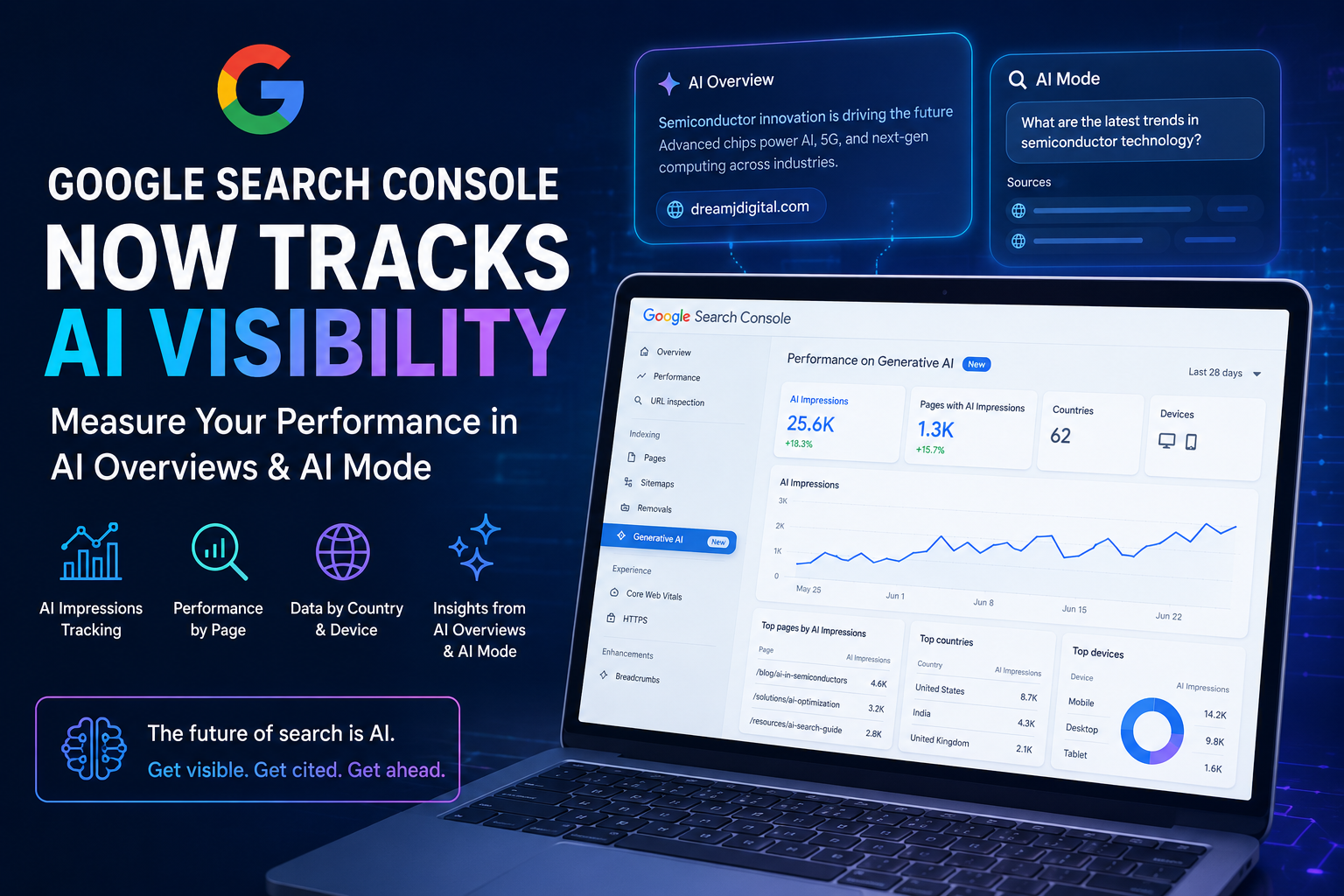
The new report appears within Google Search Console under the Performance section and focuses specifically on Generative AI features.
The report helps website owners understand:
AI Visibility Metrics
You can now see:
- AI-generated search impressions
- Visibility trends over time
- Performance by page
- Performance by country
- Performance by device
This provides a dedicated view into how your content is surfacing within Google’s AI experiences.
Search and Discover Integration
Google has also introduced AI reporting for both:
- Google Search
- Google Discover
This enables publishers to understand how AI influences visibility across Google’s broader ecosystem.
What Data Is Currently Available?
At launch, Google is primarily providing impression data.
This means you can measure:
✅ How often your content appears in AI experiences
✅ Which pages receive the most AI visibility
✅ Geographic and device-level trends
However, some important limitations remain.
Currently unavailable:
❌ AI-specific query data
❌ AI click-through rate (CTR)
❌ Dedicated AI ranking positions
❌ Conversion attribution from AI citations
Google may expand these metrics in future updates, but the initial rollout focuses on visibility measurement.
SEO Is No Longer Enough — Welcome to GEO
The introduction of AI tracking reinforces an important trend:
Search Engine Optimization (SEO) is evolving into Generative Engine Optimization (GEO).
Traditional SEO focused on ranking pages.
GEO focuses on becoming a trusted source that AI systems choose to cite and reference.
To improve visibility within AI-generated answers, brands should focus on:
1. Create Authoritative Content
AI systems prefer content that demonstrates:
- Expertise
- Experience
- Authority
- Trustworthiness
Google’s E-E-A-T principles remain critical.
2. Answer Questions Clearly
AI models frequently extract concise answers.
Use:
- FAQ sections
- Structured headings
- Direct responses
- Step-by-step explanations
This increases the likelihood of being referenced in AI summaries.
3. Strengthen Topical Authority
Rather than publishing isolated articles, build comprehensive content clusters around your niche.
For example, a semiconductor company should create interconnected content covering:
- Chip design
- Advanced packaging
- AI hardware
- Semiconductor manufacturing
- Supply chain trends
This signals expertise across an entire topic area.
4. Implement Structured Data
Schema markup helps Google understand content context.
Useful schema types include:
- Article
- FAQ
- HowTo
- Product
- Organization
While schema alone doesn’t guarantee AI visibility, it improves content understanding.
5. Focus on First-Hand Experience
AI-generated search increasingly rewards original insights and experience-based content.
Case studies, customer success stories, research findings, and industry expertise are becoming powerful differentiators.
How Businesses Should Adapt
The launch of AI reporting means businesses need to rethink how they measure search success.
Instead of focusing solely on:
- Rankings
- Organic clicks
- Keyword positions
Organizations should also monitor:
- AI impressions
- Citation frequency
- Brand mentions within AI-generated responses
- Content referenced by AI systems
This shift will become increasingly important as AI-powered search experiences continue to expand globally.
What This Means for Digital Marketers
For digital marketers, this update is a major opportunity.
For the first time, we can begin measuring how content performs inside AI-generated search experiences rather than relying on assumptions.
Organizations that understand AI visibility today will gain a significant competitive advantage as search continues evolving.
The winners in 2026 and beyond won’t simply rank higher.
They’ll become the trusted sources that AI systems choose to cite.
Conclusion
Google’s integration of AI tracking within Search Console marks the beginning of a new era in search analytics.
As AI Overviews and AI Mode reshape how users discover information, marketers must expand their focus beyond traditional SEO and embrace Generative Engine Optimization (GEO).
The ability to measure AI visibility is no longer a future capability—it’s here today.
Businesses that adapt early, create authoritative content, and optimize for AI-driven discovery will be best positioned to succeed in the next generation of search.
At DreamJDigital, we help technology companies, semiconductor brands, startups, and B2B organizations build SEO and GEO strategies that increase visibility across both traditional search and AI-powered experiences.
Need help preparing your website for AI Search? Contact DreamJDigital today.