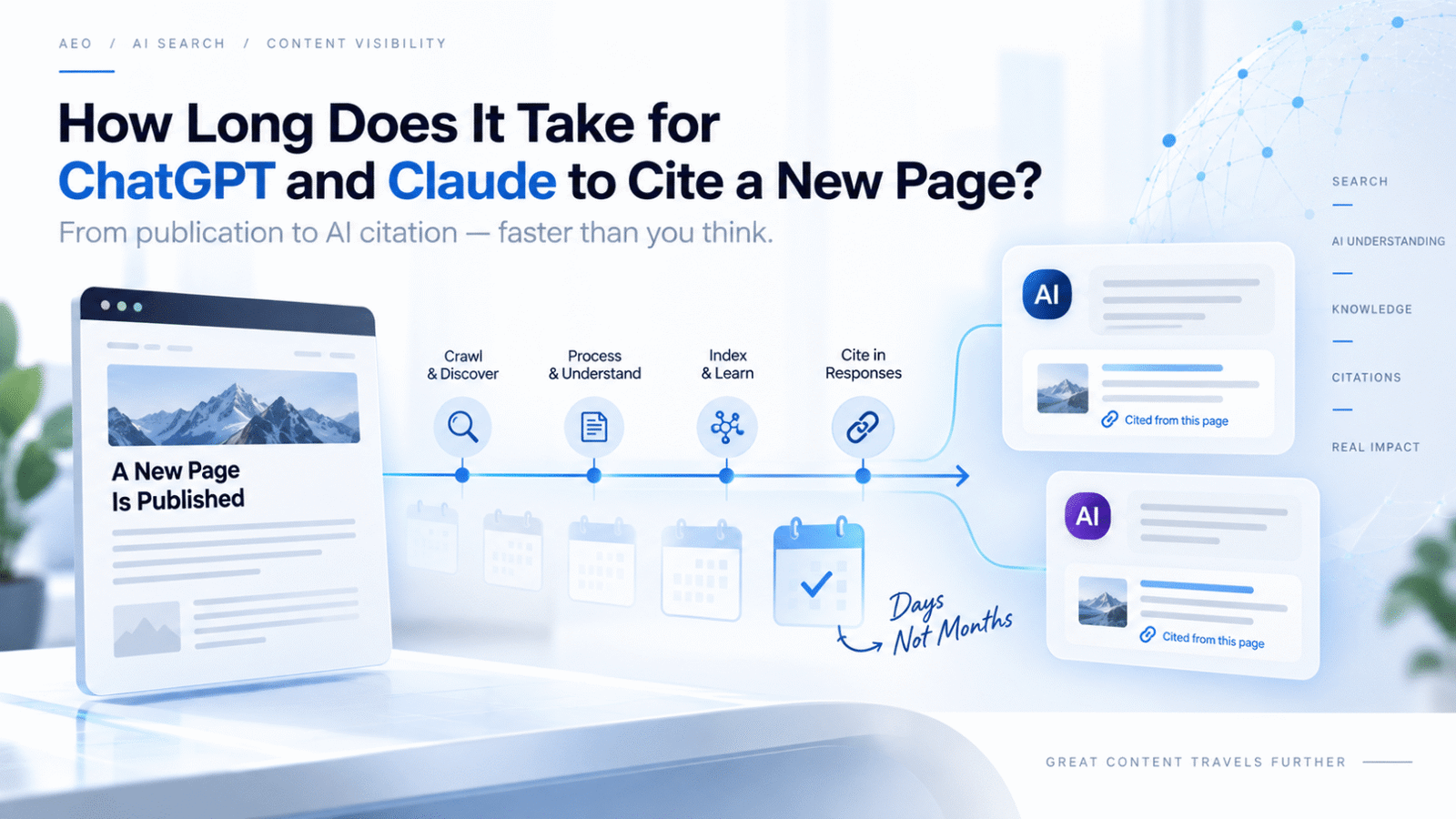
From Publishing to AI Citation: How Fast Can Your Content Get Discovered?
For years, digital marketers have been used to thinking about SEO in terms of weeks and months. Publish a page, wait for search engines to crawl and index it, build authority and gradually watch rankings improve.
But AI search is introducing a different question:
How quickly can a newly published page become a source in an AI-generated answer?
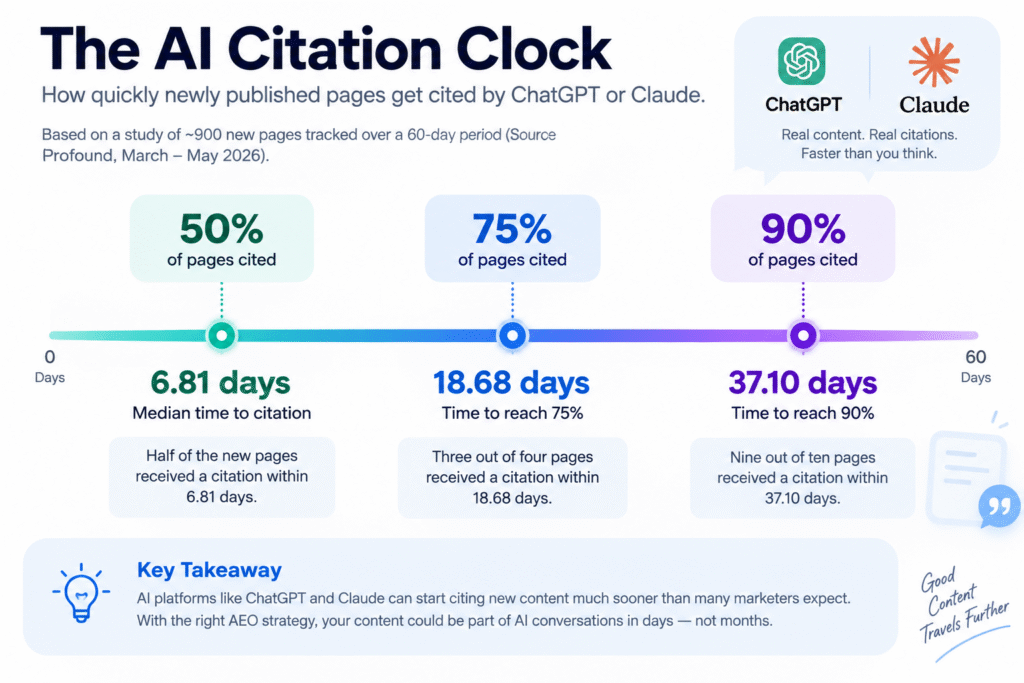
Recent research from Profound provides an interesting benchmark. The study tracked approximately 900 newly published marketing pages over a 60-day period and looked at how long it took for those pages to receive their first citation from ChatGPT or Claude. (Profound)
The numbers are surprisingly quick.
The AI Citation Clock: How Fast Can New Content Get Cited?
According to the research:
- Median: 6.81 days – half of the pages received a citation within this timeframe.
- 75th percentile: 18.68 days – three out of four cited pages received their first citation within this period.
- 90th percentile: 37.10 days – nine out of ten received a first citation within about 37 days. (LinkedIn)
That doesn’t mean every new webpage will automatically be cited within 37 days. The study is a benchmark, not a guarantee, and the publicly available methodology leaves some important questions unanswered, including how indexing delays and differences between individual AI platforms affect the results. (Josh Blyskal)
Still, the finding has an important implication for marketers: AI visibility may start much sooner than many organizations expect.
What does this mean for AEO?
This is where Answer Engine Optimization (AEO) becomes important.
Traditional SEO focuses heavily on helping a page appear in search results. AEO takes the next step: making information easy for AI systems to understand, retrieve and potentially cite when answering a user’s question.
For businesses, especially B2B and technology companies, this means simply publishing more content may not be enough.
A new product page, technical article, research report or solution page should make its subject immediately clear. Content should answer real customer questions, use descriptive headings, provide useful context, demonstrate expertise and maintain strong technical foundations such as crawlability, internal linking and structured data where appropriate.
Don’t expect results overnight
The research also provides a useful reminder about expectations.
If a company publishes an article today and doesn’t see it cited by an AI platform tomorrow, that doesn’t necessarily mean the content has failed.
AI discovery involves multiple stages – crawling, processing, understanding, indexing/retrieval and eventually citation.
Instead of asking, “Why isn’t AI citing my page yet?”, marketers should monitor the process over time.
At the same time, if important content remains invisible for an extended period, it may be worth investigating technical accessibility, content quality, internal linking, discoverability and whether the page actually answers questions people ask AI systems.
The bigger opportunity for B2B marketers
For B2B companies, this shift is particularly interesting.
A potential customer may no longer begin their research with a traditional Google search. They may ask ChatGPT, Claude or another AI system:
“What are the leading technologies for AI networking?”
“Which companies provide optical DSP solutions?”
“How does PCIe Gen6 differ from Gen5?”
If your website contains authoritative, well-structured answers to these questions, your content has an opportunity to become part of that research journey.
The key takeaway isn’t that marketers should wait 6.81 days and expect an AI citation.
It is that AI visibility is becoming something marketers can measure, analyze and optimize rather than simply hope for.
For brands investing in AEO and GEO today, the question is increasingly moving from “Will AI find our content?” to “How quickly, how often and in what contexts is AI using our content?”
That is a much more interesting marketing metric to watch.
Source: Profound research, How long does it take to get cited in ChatGPT or Claude?, published May 20, 2026. The study covered approximately 900 newly published marketing pages tracked over a 60-day period. (Profound)