Why Semiconductor and Tech Leaders Need to Start Measuring AI Search Visibility
AI search visibility is becoming increasingly important for semiconductor and technology companies as customers turn to AI-powered search for product recommendations, technology comparisons and buying decisions.
For years, technology companies have focused on a familiar goal: ranking on the first page of Google.
But search is changing.
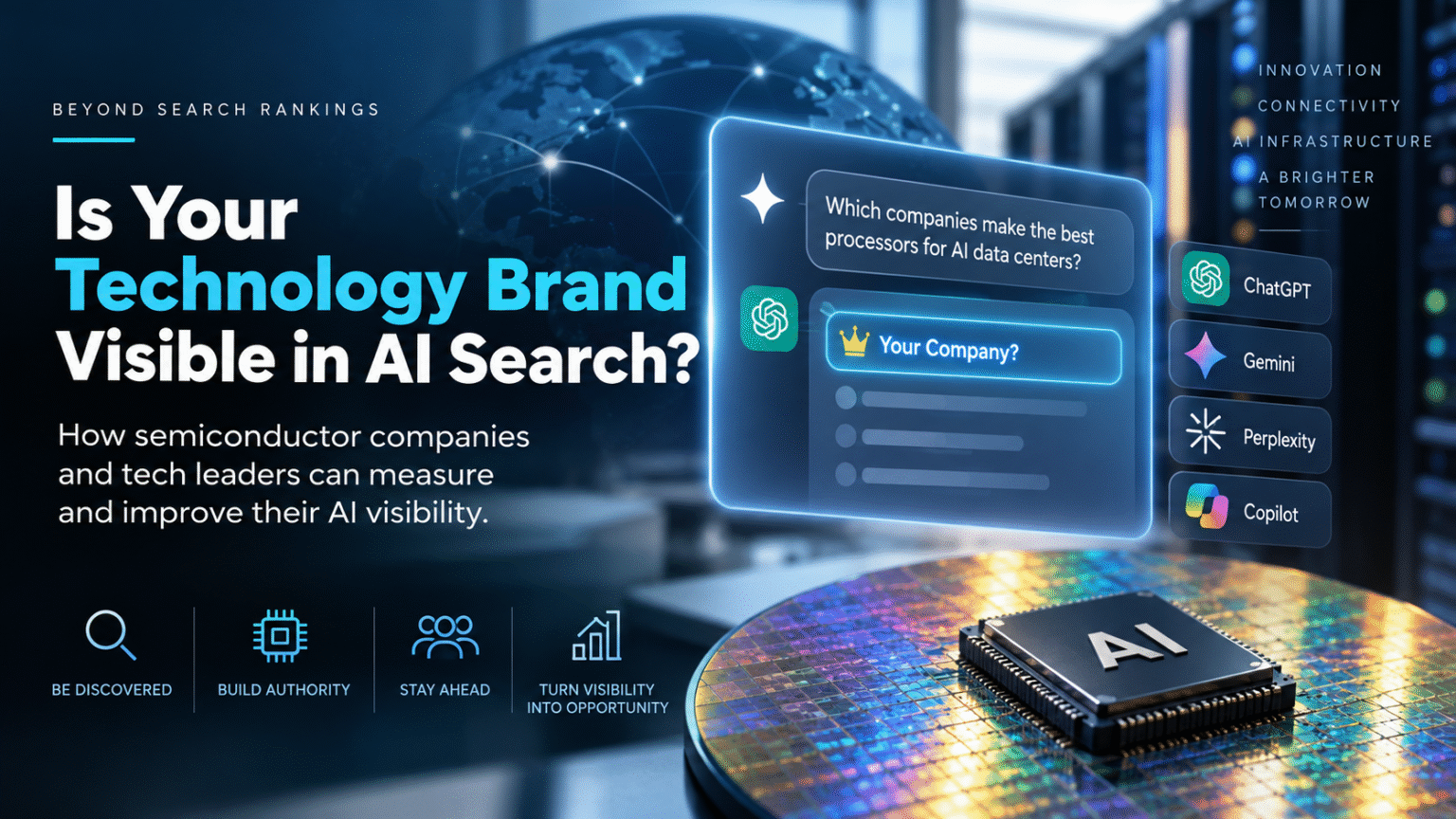
As a result, a potential customer may no longer search for “Best Networking Processor” or “Leading Semiconductor Companies for AI Infrastructure.” Instead, they may ask ChatGPT, Gemini, Perplexity or another AI assistant:
“Which companies make the best processors for AI data centers?”
or:
“What are the leading alternatives for high speed connectivity in AI infrastructure?”
The answer may contain only a handful of companies. Your company can rank highly in traditional search and still be absent from that answer.
That creates a new challenge for semiconductor companies, technology vendors and startups: How visible is your brand inside AI-generated answers?
This is where AI Search Visibility and Answer Engine Optimization (AEO) become important.
SEO Is Still Important-But It Is No Longer the Whole Picture
Traditional SEO focuses on how well your web pages rank for search queries.
AI search works differently. AI systems synthesize information from multiple sources and produce an answer rather than simply displaying a list of links.
For a technology company, this means your visibility depends not only on your own website, but also on how your company is represented across the broader web.
AI systems may draw information from:
- Your corporate website
- Industry publications
- Technical articles and research
- Analyst reports
- News coverage
- Review and comparison websites
- Community discussions and forums
- Third-party technology publications
- Reference sources
Therefore, AI visibility is increasingly a measure of your overall digital reputation and authority-not simply your website’s SEO performance.
Start With the Questions Your Customers Actually Ask
The first step is to identify the questions that matter commercially.
Look at the search queries for which your company already performs well, particularly those related to:
- Products and technologies
- Solutions
- Competitors
- Alternatives
- Pricing or cost considerations
- Performance
- Use cases
- Industry applications
Then transform those keywords into natural questions a real customer might ask an AI assistant.
For example, instead of tracking:
“AI networking chips”
track questions such as:
“Which companies provide networking chips for AI data centers?”
Or instead of:
“5G semiconductor suppliers”
track:
“Which semiconductor companies are leading in 5G infrastructure?”
Go further by adding realistic buying constraints:
“Which semiconductor companies provide high-performance networking solutions for large AI data centers?”
These detailed questions are much closer to how customers increasingly interact with AI.
Measure AI Search Visibility Beyond Mentions
Simply asking an AI assistant whether it knows your company isn’t enough.
A useful AI visibility audit should measure at least four things.
1. Mention Rate
How frequently does the AI assistant mention your company?
For example:
If your company appears in 40 out of 100 relevant prompts, your mention rate is 40%.
2. Recommendation Rate
Being mentioned is not the same as being recommended.
A company could be mentioned as one of many industry players without being presented as a company the customer should consider.
Track how frequently your company appears among the leading recommendations.
3. Share of Voice
Look at your company relative to competitors.
If AI systems mention five semiconductor companies in response to a particular set of questions, how frequently does your company appear compared with those competitors?
This gives technology leaders a more meaningful view of competitive positioning.
4. Citation Sources
Perhaps the most valuable question is:
Where is the AI getting its information about us?
Record the websites and sources cited in AI-generated answers.
This can reveal something important: the sources influencing your AI visibility may not be the sources you expected.
Find Your AI Search Visibility Gap
One of the most useful exercises is to compare your traditional search performance with your AI visibility.
For example:
| Traditional Search | AI Search |
|---|---|
| Company ranks in Google’s top 10 | Company is not mentioned |
| Product page ranks well | Competitor is recommended |
| Strong website traffic | AI cites third-party sources instead |
| Good SEO visibility | Weak AI visibility |
These are AI visibility gaps.
For technology companies, these gaps can reveal areas where marketing and communications teams need to strengthen the company’s presence beyond its own website.
Look Beyond Your Own Website
One of the most important lessons is that your website is only one part of the information ecosystem.
In addition, AI systems may rely heavily on third-party sources when forming recommendations.
Depending on your industry, these could include:
Industry Publications
Ensure your company, technologies and executives are accurately represented in credible technology and semiconductor publications.
Analyst and Research Sources
Independent analyst coverage can contribute to how your company is perceived within a technology category.
Industry Communities
Technical communities and discussion forums can influence how technologies and vendors are perceived.
The goal should not be artificial promotion. Instead, technical experts should participate genuinely by answering questions, correcting inaccuracies and sharing useful knowledge.
Third-Party Comparison Articles
Articles comparing technologies, vendors or solutions can become influential sources.
Make sure your specifications, capabilities and product information are accurate and current wherever your company is legitimately represented.
News and PR
Product launches, technology breakthroughs, partnerships, acquisitions and executive perspectives can create independent sources that reinforce your company’s authority.
Make Your Website Easier for AI to Understand
Your own website remains fundamental.
AI systems need to understand what your company does, what technologies you provide and where your products fit into the market.
Technology companies should therefore make important information clear and explicit.
For example, don’t make visitors or AI systems work through several pages to determine what a product actually does.
Lead with the answer.
Instead of:
“Our company has been innovating in advanced connectivity technologies for more than two decades…”
say:
“Company X provides high-speed connectivity solutions for AI data centers, cloud infrastructure and enterprise networks.”
Then provide supporting technical details.
Useful content includes:
- Clear product descriptions
- Technical specifications
- Use cases
- Industry applications
- Comparison pages
- FAQs
- Glossaries
- Architecture explanations
- Developer documentation
- White papers
- Technical blogs
- Customer use cases
The objective is not to “write for AI.” It is to make authoritative information easy for both humans and machines to understand.
Create Content That Answers Technical Questions
For semiconductor and deep-tech companies, this is particularly important.
A strong content strategy should go beyond promotional product announcements.
Consider publishing content that answers questions such as:
- How does this technology work?
- Where is it used?
- How does it compare with alternative architectures?
- What are the performance trade-offs?
- What workloads is it designed for?
- How does it fit into AI infrastructure?
- What problems does it solve?
- When should customers choose this architecture instead of another?
This type of technical thought leadership can help establish your company as an authoritative source rather than simply another vendor.
Build an AI Search Visibility Dashboard
Technology leadership teams don’t need an overly complicated system to begin.
Start with a simple spreadsheet.
Create a list of perhaps 50-100 commercially important AI prompts.
Run those prompts periodically across multiple AI search platforms and record:
- AI platform
- Prompt
- Companies mentioned
- Order of companies mentioned
- Whether your company was mentioned
- Whether your company was recommended
- Sources cited
- Competitors appearing instead
- Changes from the previous measurement
Over time, this creates a valuable picture of how AI systems perceive your brand and technology category.
What Technology Leaders Should Watch
AI visibility should eventually become another component of the company’s digital-performance dashboard.
Leadership teams can monitor:
Brand visibility – Are AI systems aware of us?
Recommendation visibility – Are they recommending us?
Competitive share of voice – Are competitors appearing more frequently?
Citation authority – Which external sources influence our representation?
Accuracy – Is AI describing our products and capabilities correctly?
Coverage gaps – Which important customer questions don’t include us?
Trend – Is our AI visibility improving over time?
The Bigger Strategic Shift
The biggest takeaway is not that companies should abandon SEO.
They shouldn’t.
SEO remains the foundation because AI systems still need accessible, well-structured and authoritative information.
The shift is that companies now need to think beyond “Where do we rank?”
The more important questions are becoming:
“Does AI know us?”
“How well does AI understand what we do?”
“When customers ask relevant questions, does AI consider us?”
“And does it recommend us over our competitors?”
And perhaps most importantly:
“Which sources are influencing that recommendation?”
For semiconductor companies and technology startups, this represents a significant opportunity.
Companies that consistently publish authoritative technical content, earn credible third-party recognition, participate in relevant industry communities and maintain accurate product information can build an information footprint that extends far beyond their own website.
In the age of AI-powered search, digital visibility is no longer just about owning the answer on your website. It is about becoming part of the trusted information ecosystem from which AI builds the answer.
That is a shift technology leaders should start measuring now.