Search Engine Optimization (SEO) is constantly evolving. Businesses invest time and money in improving website content, updating page titles, optimizing meta descriptions, improving website structure and implementing technical SEO changes. But an important question often remains unanswered: How do we know whether these changes are actually working?
Many businesses measure SEO success by comparing website traffic before and after implementing changes. For example, if organic traffic increases after updating product pages, it is tempting to conclude that the changes were successful.
However, traffic growth alone does not necessarily prove that an SEO improvement caused the increase. Search engine algorithm updates, seasonal trends, competitor activities and changes in customer demand can all influence website performance.
This is where SEO split testing comes in. It provides a more structured, data-driven approach to understanding which SEO changes deliver measurable results.
What Is SEO Split Testing?
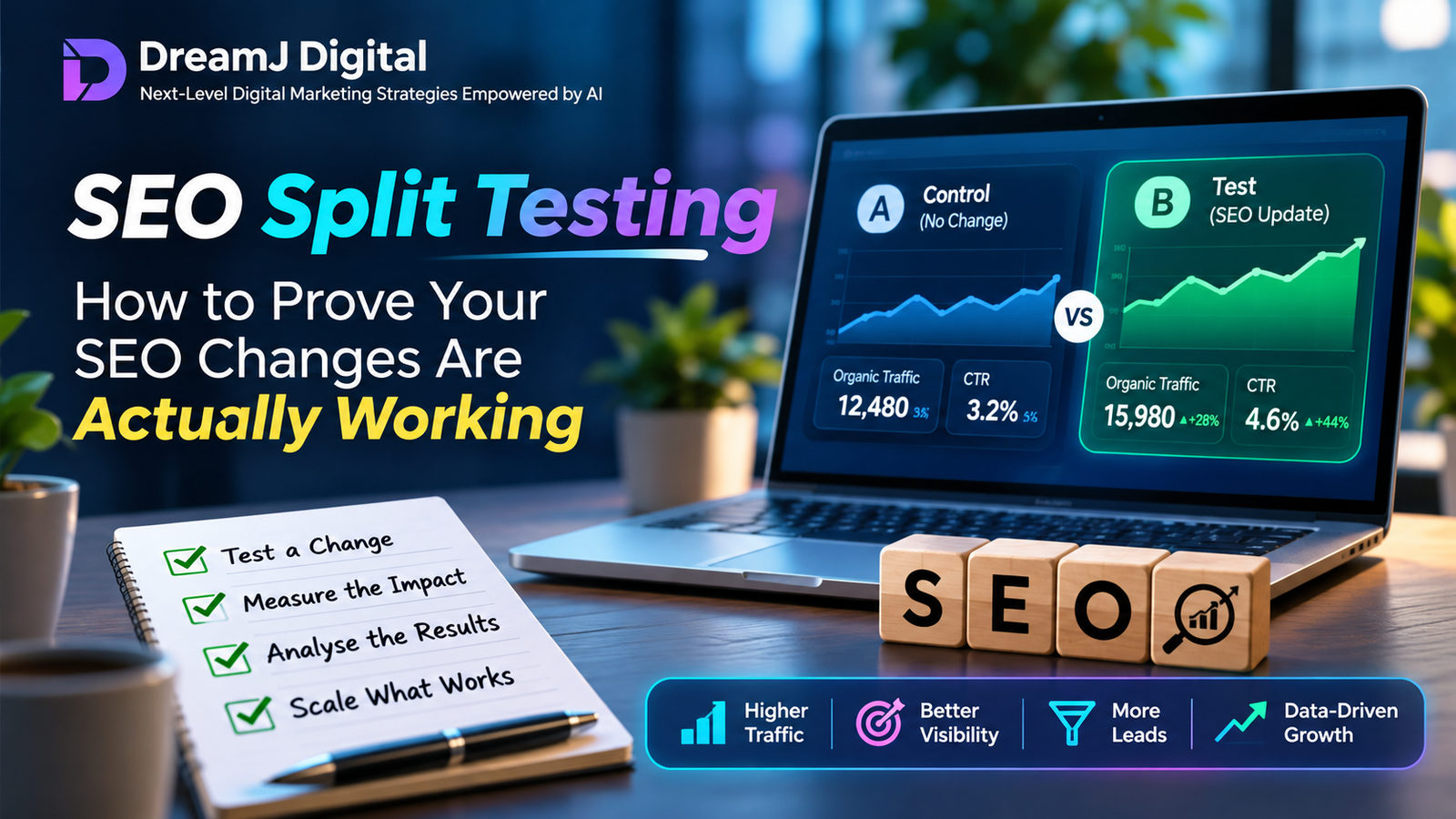
SEO split testing is a method of testing website changes to understand their actual impact on organic search performance.
Instead of updating every page at once, businesses divide similar website pages into two groups:
- Test Group: Pages where the proposed SEO changes are implemented.
- Control Group: Similar pages that remain unchanged during the testing period.
Both groups are monitored over the same period. By comparing their performance, businesses can estimate whether the changes made to the test group contributed to improvements in organic search traffic.
For example, imagine an e-commerce website with 200 product pages. The marketing team wants to improve page titles and meta descriptions to increase organic clicks.
They could update 100 pages while leaving the remaining 100 unchanged. After collecting sufficient data, they can compare the performance of both groups to understand whether the new approach generated additional organic traffic.
This provides stronger evidence than simply comparing website traffic before and after an update.
Why Traditional SEO Performance Measurement Is Not Enough
SEO results are influenced by several external factors. Even when your website remains unchanged, organic traffic can fluctuate.
Some common reasons include:
- Google Algorithm Updates: Changes to search algorithms can affect website rankings and visibility.
- Seasonal Trends: Customer searches may increase or decrease depending on the time of year.
- Competitor Activities: Competitors may publish better content or improve their websites.
- Marketing Campaigns: Paid advertising, PR and brand awareness campaigns can increase branded searches.
- Technical Issues: Tracking problems, website changes or cookie consent settings can affect reported performance.
Additionally, AI-powered search experiences, including Google AI Overviews and AI Mode, are changing how users discover information and interact with search results.
Therefore, an increase or decrease in organic traffic does not automatically mean that your SEO strategy is responsible.
The goal should be to understand what would have happened without the changes and compare that with the actual results.
How to Conduct an SEO Split Test
A successful SEO experiment requires planning, a clear objective and reliable measurement.
Here are five important steps businesses should follow.
1. Define Your Objective and Hypothesis
Before making any changes, identify what you want to improve.
For example:
- Will rewriting page titles increase organic clicks?
- Will adding relevant FAQs improve search visibility?
- Will improving internal linking help important pages perform better?
- Will adding structured data improve how search engines understand website content?
Create a clear hypothesis explaining what you plan to change and why you expect it to work.
Also, decide which metric will determine success. This could be organic clicks, impressions, conversions or qualified leads.
2. Divide Pages into Test and Control Groups
Select similar pages that have comparable traffic levels, search intent and website structure.
Implement the proposed changes only on the test group. Keep the control group unchanged.
It is important to avoid testing pages that compete for exactly the same search queries in separate groups, as this can affect the accuracy of the results.
For larger websites, automated SEO testing platforms can help organize and monitor these experiments.
3. Monitor Both Groups Over the Same Period
Both groups should be monitored simultaneously to reduce the influence of external factors.
Tools such as Google Search Console and Google Analytics 4 (GA4) can help track important performance indicators.
For meaningful comparisons, monitor complete weeks rather than selecting random dates. This helps account for differences in weekday and weekend traffic.
The testing duration will depend on website traffic, the type of change and the amount of data required to reach a reliable conclusion.
4. Measure the Right Metrics
SEO success should not be measured by rankings alone.
Consider monitoring:
- Organic clicks and impressions.
- Search engine rankings.
- Click-through rate (CTR).
- Organic conversions and qualified leads.
- Revenue generated through organic search.
- Visibility in AI-powered search experiences, where reliable reporting data is available.
One important consideration is that higher traffic does not always mean better business performance. Ultimately, the objective is to attract relevant visitors who are more likely to become customers.
5. Analyse the Results Before Making Decisions
Once the testing period is complete, compare the test group against the control group.
Look beyond percentage increases. Consider the reliability of the results, possible external influences and whether the improvement is meaningful for the business.
Based on the findings, decide whether to implement the change across the remaining pages, reverse it or conduct further testing.
Not every experiment will produce positive results. Even unsuccessful tests provide valuable insights into what works and what does not.
Different SEO Testing Methods for Different Websites
Not every website has sufficient traffic or page volume to conduct traditional split testing.
Depending on the website size and business requirements, different approaches can be used:
- Page Split Testing: Suitable for large e-commerce websites, marketplaces and websites with multiple similar pages.
- Geographic Split Testing: Useful for businesses operating across different cities, regions or countries. Changes can be tested in selected markets before wider implementation.
- Modeled Baseline Testing: Useful when changes affect the entire website and there is no suitable group of unchanged pages for comparison.
- Before and After Comparison: A simpler approach for smaller websites, although it cannot reliably separate the impact of SEO changes from external factors.
The important thing is to choose a testing method that matches your website’s size, traffic and available resources.
The Growing Importance of AI Search Visibility
SEO is no longer limited to traditional Google search results.
AI-powered search platforms are changing how people discover businesses, research products and find answers online.
Google AI Overviews, AI Mode and conversational AI platforms are creating new opportunities for businesses to gain visibility.
As a result, SEO measurement is gradually expanding beyond traditional rankings and organic clicks.
Businesses should also pay attention to how their content appears in AI-generated answers, whether their website provides useful and trustworthy information and whether important pages are structured in a way that search engines and AI systems can understand.
This makes structured content, relevant FAQs, clear explanations and appropriate schema markup increasingly important elements of a modern SEO strategy.
Conclusion: Make SEO Decisions Based on Evidence, Not Assumptions
SEO is a continuous process of improvement, experimentation and learning. However, implementing changes without measuring their actual impact can lead to wasted time and marketing budgets.
SEO split testing helps businesses move beyond assumptions and make decisions based on measurable evidence.
Whether you are improving page titles, updating website content, optimizing product pages or introducing a new website structure, testing provides a clearer understanding of what delivers results.
The key takeaway is simple: Don’t just make SEO changes. Test them, measure their impact and scale the improvements that work.
At DreamJ Digital, we believe successful digital marketing combines creativity, technology and data driven decision making. A well planned SEO strategy should not only improve search visibility but also contribute to meaningful business growth.