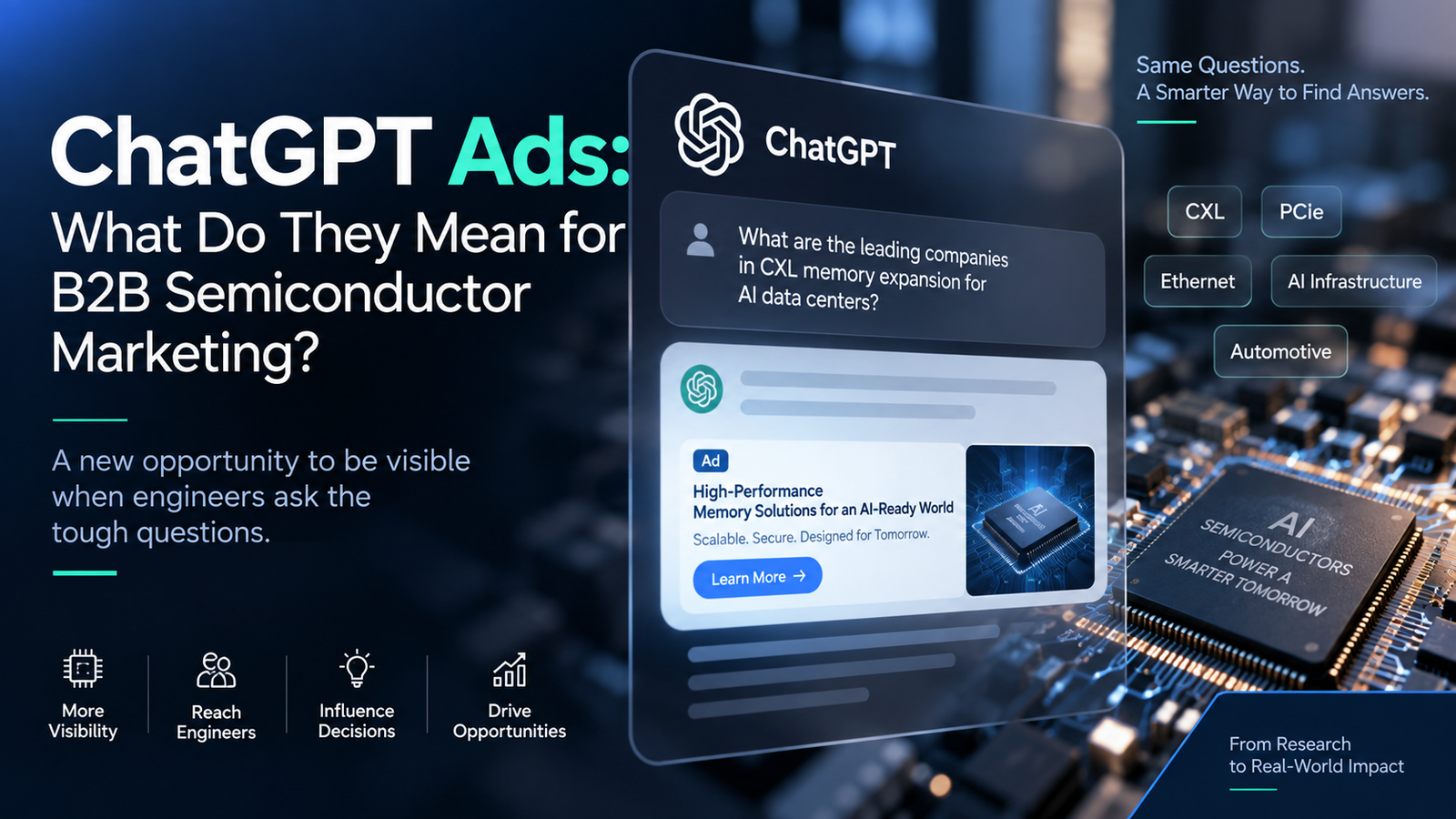
ChatGPT Ads for semiconductor companies are becoming an important topic as AI-driven discovery changes how engineers, architects and technology decision makers research products and technologies.
A website visit doesn’t necessarily mean a lead. A click doesn’t mean a customer. And a marketing campaign may influence a design decision months or even years before a product is actually purchased.
That is why the emergence of ChatGPT Ads is worth watching.
Not because semiconductor companies should suddenly move their advertising budgets away from Google, LinkedIn or industry publications.
But because the way engineers, architects and technology decision makers discover information is changing.
Search Engine Land recently highlighted ChatGPT Ads as an opportunity worth testing, largely because the platform is still developing and competition remains relatively limited. At the same time, the article cautions marketers not to confuse an early opportunity with a long term media strategy.
For semiconductor marketers, I believe there is an even bigger question.
When engineers ask AI about a technology, is your company part of the answer?
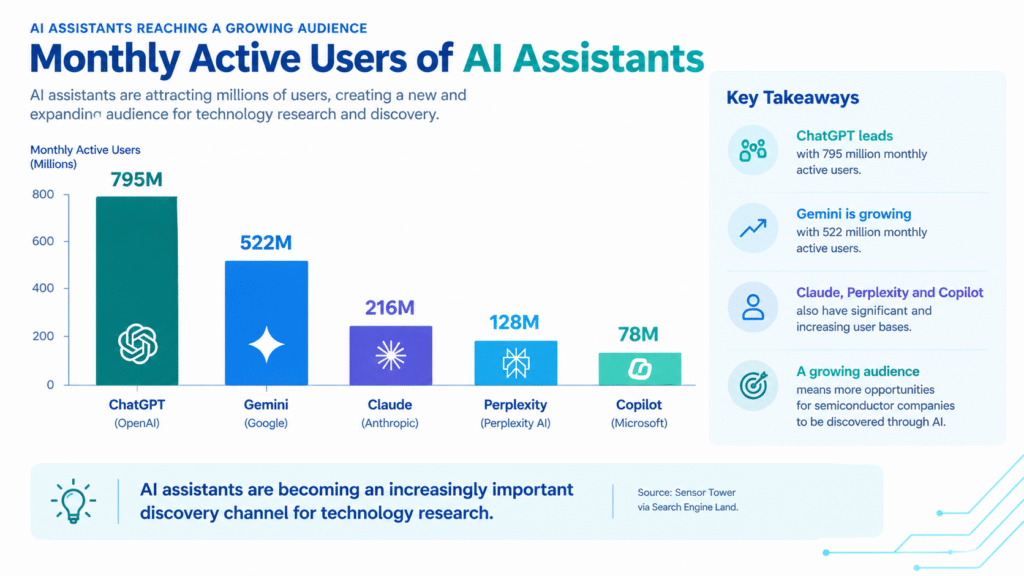
The search box is becoming a conversation
Consider how an engineer might traditionally search for a technology:
“PCIe Gen 6 retimer vendors”
Now compare that with:
“What should I consider when selecting a PCIe Gen 6 retimer for an AI server and which semiconductor companies have suitable solutions?”
The second question is much closer to the way technical research actually happens.
The user isn’t simply looking for a keyword. They are looking for context, comparison, recommendations and expertise.
That is where AI-driven discovery becomes interesting for semiconductor companies.
The opportunity isn’t simply another place to generate clicks.
It is the possibility of being visible inside the research conversation that may eventually influence a technology decision.
Why this matters for semiconductor companies
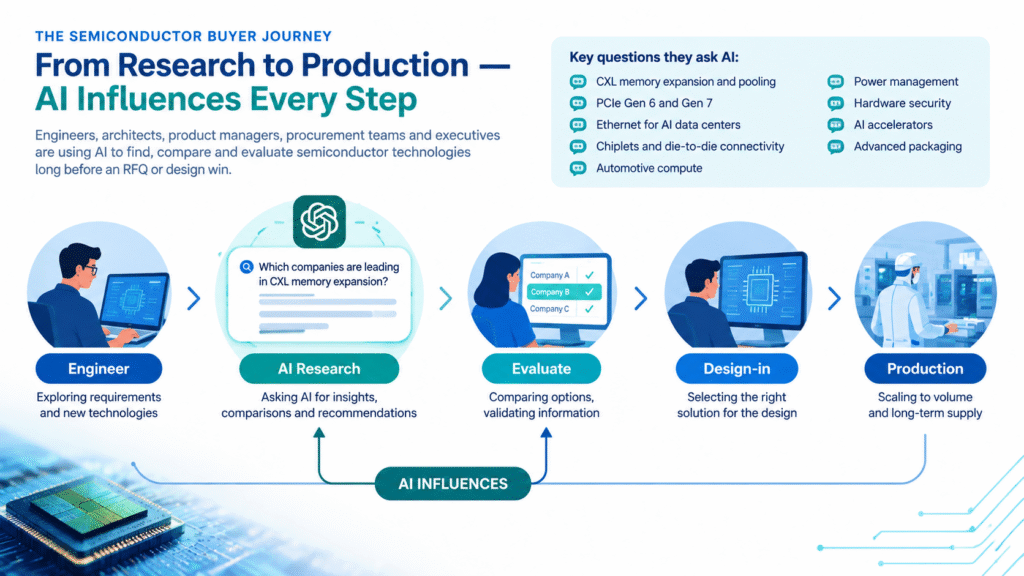
A semiconductor buying journey can involve many people:
- Engineers evaluating architectures
- System architects comparing technologies
- Product managers assessing solutions
- Procurement teams evaluating suppliers
- CTOs and executives considering long-term technology direction
Long before an RFQ or design win, these people are researching.
They may ask AI about:
- CXL memory expansion and pooling
- PCIe Gen 6 and Gen 7
- Ethernet for AI data centers
- Chiplets and die-to-die connectivity
- Automotive compute
- Power management
- Hardware security
- AI accelerators
- Advanced packaging
This creates a new kind of marketing question:
What does AI say about your company when your customers ask these questions?
The bigger opportunity may not be the advertisement
This is the part I find most interesting.
The question for a semiconductor CEO shouldn’t simply be:
“Should we advertise on ChatGPT?”
It should be:
“Are we visible when our customers use AI to research our technology category?”
Imagine an engineer asking:
“Who are the leading companies in CXL memory expansion?”
Or:
“What are the key considerations when selecting an 800G Ethernet solution for an AI data center?”
If competitors consistently appear in those conversations while your company doesn’t, buying an advertisement may not solve the underlying problem.
You may have an AI visibility and content problem.
Technical content is becoming even more important
This has major implications for semiconductor marketing.
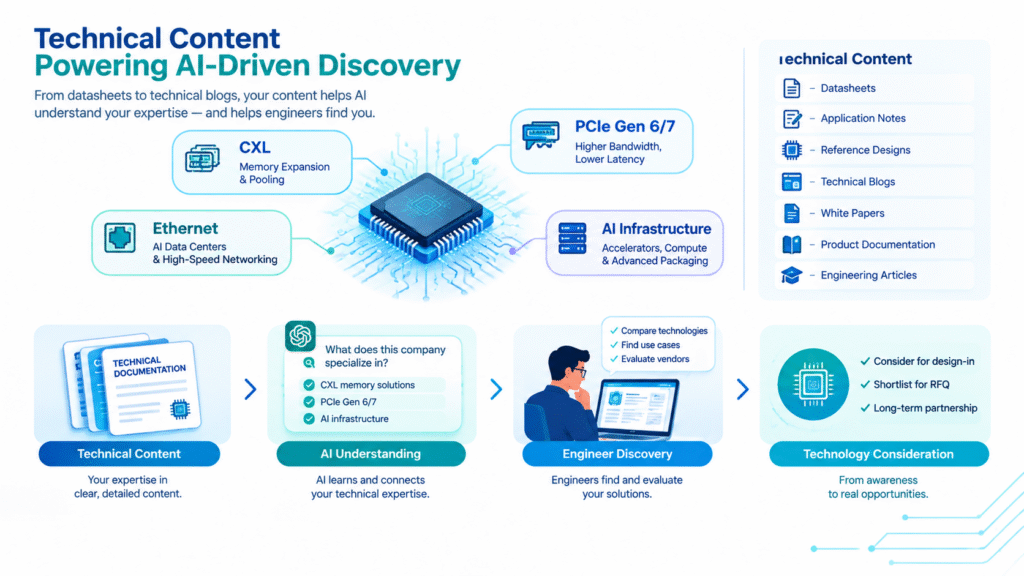
Datasheets, application notes, reference designs, technical blogs, white papers, product documentation and engineering articles have traditionally been created to educate customers and support sales.
They now have another role.
They help AI systems understand:
What does this company know?
Which technologies does it specialize in?
What applications does it support?
Why should an engineer consider it?
That means semiconductor marketing teams need to think beyond traditional SEO and keyword rankings.
A generic product announcement may generate short term attention.
A technically useful article such as:
“How CXL Enables Memory Expansion in AI Server Architectures”
or
“PCIe Gen 6 vs. Gen 5: What Changes for Next-Generation Data Centers?”
can demonstrate genuine expertise and answer the questions engineers are actually asking.
So, should semiconductor companies test ChatGPT Ads?
Yes but as an experiment, not a major budget shift.
ChatGPT Ads are still a relatively new advertising channel. The platform has been adding capabilities such as conversion focused campaigns, automated bidding and additional targeting options, making it increasingly similar to more established advertising platforms.
For a semiconductor company, a sensible approach would be to start small.
Test campaigns around a few high value technologies or products.
Measure more than clicks:
- Quality of traffic
- Engagement with technical content
- High-value conversions
- Requests for information
- Product interest
- Influence on qualified pipeline
The objective should initially be learning, not scale.
Start testing your AI visibility today
There is another experiment every semiconductor marketing team can do right now and it doesn’t require an advertising budget.
Open ChatGPT, Gemini or another AI assistant and ask questions your customers might ask.
For example:
“Who are the leading vendors for PCIe Gen 6 retimers?”
“Which companies offer CXL memory expansion solutions?”
“What semiconductor technologies are important for AI data centers?”
Then look carefully at the answers.
Are you mentioned?
Are your competitors mentioned?
Is the information about your company accurate?
Are your products associated with the right applications?
This simple exercise can reveal an entirely new type of competitive gap.
The real opportunity
I wouldn’t recommend that a semiconductor CEO move a significant portion of the company’s marketing budget to ChatGPT Ads today.
But I would recommend starting to experiment with AI-driven discovery now.
Because the bigger shift isn’t necessarily the advertisement.
It is the question.
When an engineer, architect, CTO or technology executive asks AI an important question about your market, your technology or your competitors, what does the AI say about your company?
That may eventually matter much more than where your company ranks on a traditional search results page.
The next generation of B2B semiconductor marketing may not be about being the first link someone clicks.
It may be about being part of the answer they trust.